SEO is one of those terms almost every business owner has heard, but far fewer understand properly.
Some think it is just about keywords. Others assume it is a technical task handled by developers behind the scenes. Some believe SEO is about chasing Google’s algorithm or finding shortcuts to rank quickly.
In reality, SEO is both simpler and much bigger than that.
Search Engine Optimisation (SEO) is the process of improving your website so search engines can understand it, trust it, and show it to the right people at the right time.
It is how businesses increase visibility in organic search results, attract relevant traffic, and turn that traffic into leads, sales, and long-term growth.
But proper SEO is not just about rankings. It is about relevance, usefulness, and becoming the best possible answer for the searches your audience is already making.
That is why SEO matters so much. It connects your business with people who are actively looking for what you do.
This guide breaks down:
- What SEO is
- How SEO works
- Why SEO matters
- The core parts of SEO
- How beginners can start building a strategy that actually works
What is SEO?
SEO stands for Search Engine Optimisation.
It is the practice of improving a website so it appears more prominently in organic search engine results for relevant queries.
When someone searches on Google, they see a mix of results:
- Paid adverts
- Local listings
- Product results
- Organic website listings
SEO focuses on improving visibility within those organic results and across the wider search landscape.
At its core, SEO helps search engines answer three simple questions about your website:
- What is this page about?
- How useful is it?
- Should it appear for this search?
If your website makes those answers clear, you have a much stronger chance of ranking.
However, search engines do much more than just read text. They must:
- Discover your pages
- Understand your content
- Evaluate whether it satisfies search intent
- Compare it with competing pages across the web
That is why SEO is never just one thing.
It involves:
- Technical improvements
- Content strategy
- On-page optimisation
- Internal linking
- Site structure
- User experience
- Authority building
Together, these elements improve how visible and competitive your site is in search.
Why SEO Matters
SEO matters because search is one of the main ways people discover businesses, services, products, and information online.
When someone has a question or problem, they usually search first.
Examples might include:
- “what is seo”
- “best seo agency in london”
- “buy standing desk uk”
These searches are valuable because they reveal intent.
The user is actively looking for something rather than being interrupted by marketing.
This makes SEO one of the most commercially valuable digital channels available.
A strong SEO strategy helps businesses:
- Increase visibility when people search
- Attract high-intent traffic
- Build trust through useful content
- Reduce reliance on paid advertising
- Create a long-term source of leads and revenue
- Strengthen brand authority
Unlike many marketing channels, SEO continues working long after the page is published.
A well-optimised page can generate traffic for months or even years.
That is why SEO is not just a marketing tactic.
It is an asset-building growth channel.
What Does SEO Actually Mean in Practice?
In practice, SEO means improving your website so it performs better in search results.
This involves ensuring:
- The technical foundations are strong
- The content is genuinely useful
- The site structure is logical
- Your website sends strong relevance and trust signals
For example, if you run an SEO agency in Manchester, SEO might involve:
- Creating a service page targeting “SEO agency Manchester”
- Writing supporting content around keyword research, technical SEO, and backlinks
- Improving site speed and mobile usability
- Structuring internal links so key pages are easy to find
- Earning backlinks from credible industry websites
- Ensuring pages match the intent behind searches
SEO should never be reduced to “adding keywords to a page.”
Keywords matter, but they are only one part of a much larger system.
How Search Engines Work
To understand SEO properly, you need to understand how search engines work behind the scenes.
Search engines like Google organise vast amounts of information and return the most useful results for every search.
They typically operate in three main stages:
Crawling
Crawling is the discovery stage.

Search engines use automated bots called crawlers or spiders to explore the web.
They discover pages by:
- Following links from one page to another
- Reading XML sitemaps
- Revisiting pages to detect updates
If your pages cannot be crawled, they are unlikely to appear in search results.
Common crawling issues include:
- Broken internal links
- Poor site structure
- Blocked pages
- Technical barriers preventing bots from reading content
A website with clear navigation and strong internal linking is much easier for search engines to crawl.
Indexing
Once discovered, search engines attempt to understand and store the page in their index.

The index is essentially a massive database of web content.
If a page is not indexed, it cannot appear in search results.
During indexing, search engines analyse:
- Page content
- Headings
- Links
- Images and media
- Context across the site
Pages may fail to be indexed if they are:
- Blocked
- Duplicate
- Technically incorrect
- Too weak to justify indexing
Publishing a page does not automatically mean it will rank.
It must first be discovered, understood, and indexed.
Ranking
When someone performs a search, the engine retrieves pages from its index and ranks them based on usefulness and relevance.

Search engines evaluate hundreds of signals to determine rankings.
Broadly, they prioritise pages that are:
- Relevant to the query
- Aligned with search intent
- Trustworthy and authoritative
- Well structured
- Easy to use
SEO works by strengthening the signals that demonstrate these qualities.
How SEO Works
SEO works by improving the signals that help search engines understand and trust your website.
At a high level, good SEO:
- Makes your website easier to discover
- Helps search engines understand each page
- Aligns content with search intent
- Builds authority over time
For example, if someone searches “what is technical SEO”, the pages most likely to rank will include:
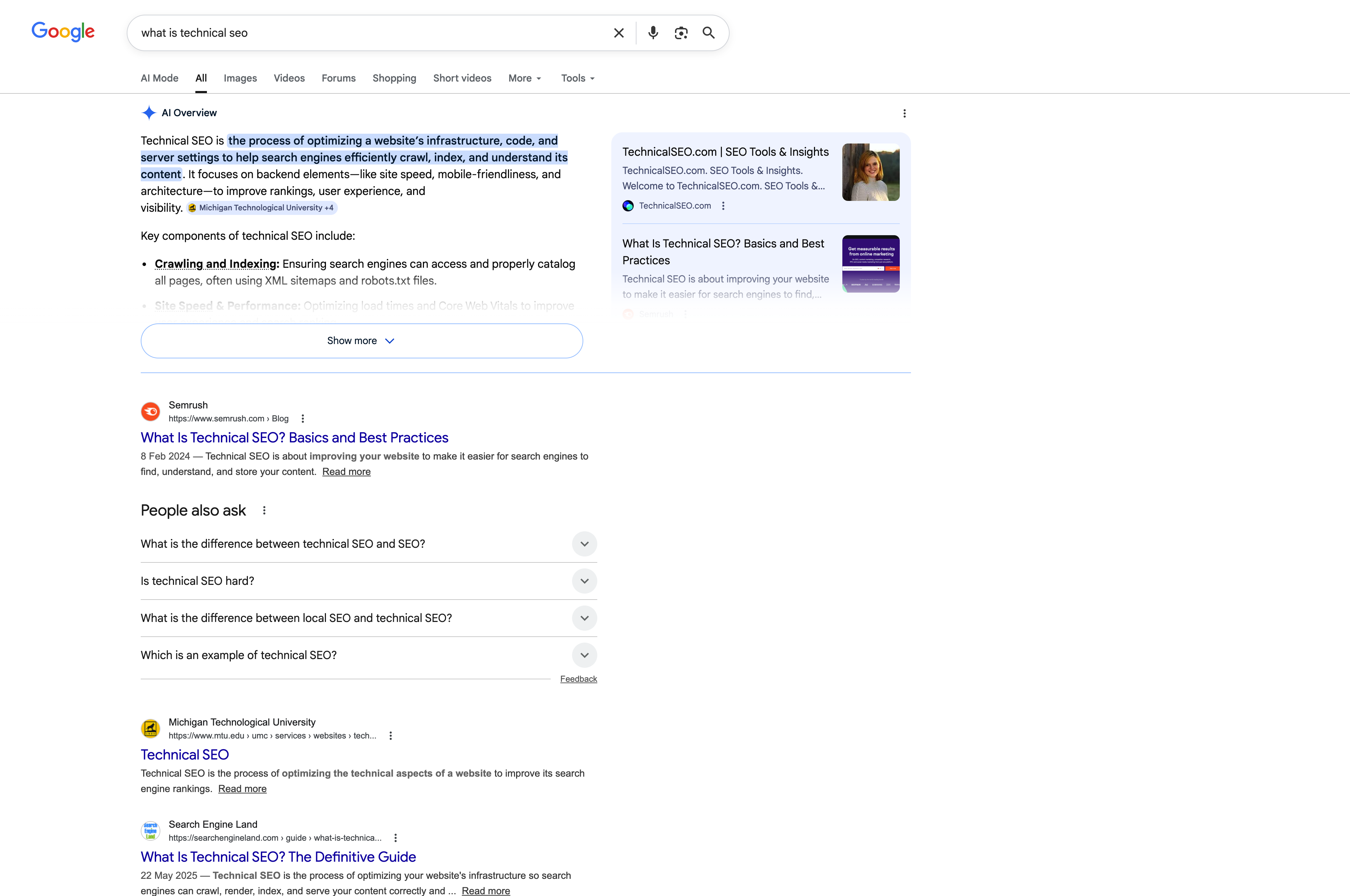
- Clear explanations
- Structured headings
- Comprehensive content
- Supporting subtopics
- Helpful internal links
- Strong site authority
SEO improves all of these factors.
Put simply: SEO is the process of making your website easier to find, easier to understand, and more deserving of visibility.
The Main Types of SEO
SEO is usually divided into several core areas.
Each plays a different role in improving search visibility.
Technical SEO
Technical SEO focuses on the infrastructure of your website.
It ensures search engines can crawl, render, and index your pages correctly.
Key areas include:
- Site speed
- Mobile usability
- XML sitemaps
- Robots directives
- Canonical tags
- Structured data
- Duplicate content management
- Website architecture
- HTTPS security
- Redirect management
Technical SEO creates the conditions for all other SEO work to succeed.
Without it, even excellent content may struggle to rank.
On-Page SEO
On-page SEO refers to elements optimised directly on a page.
These include:
- Title tags
- Meta descriptions
- Headings
- Content structure
- Internal links
- Image optimisation
- URL structure
- Schema markup
On-page SEO helps search engines understand the topic of the page while helping users decide whether to click the result.
It is not about keyword stuffing.
It is about building pages that genuinely match user intent.
Content SEO
Content is central to SEO success.
Content SEO focuses on creating valuable content aligned with real search behaviour.
This includes:
- Understanding search intent
- Targeting the right topics
- Covering relevant subtopics
- Creating depth and clarity
- Building topic clusters
- Updating outdated pages
Strong content helps websites:
- Rank for more searches
- Build topical authority
- Earn backlinks
- Support conversions
Off-Page SEO
Off-page SEO refers to signals outside your website that influence credibility.
The most important of these signals is backlinks.
Backlinks are links from other websites pointing to yours.
They help search engines understand whether your website is trusted by others.
However, quality matters far more than quantity.
A single editorial link from a respected publication is often far more valuable than dozens of weak links.
Off-page SEO also includes:
- Digital PR
- Brand mentions
- Industry citations
- Media coverage
- Thought leadership
Local SEO
Local SEO focuses on helping businesses appear in geographically relevant searches.
Examples include:
- “SEO agency Leeds”
- “plumber near me”
Local SEO involves:
- Google Business Profile optimisation
- Local landing pages
- Local citations
- Reviews
- Location-based content
- Local backlinks
For businesses serving specific locations, local SEO is essential.
What Are Search Queries and Keywords?
A search query is what someone types into a search engine.
A keyword is the topic or phrase a page targets.
However, modern SEO focuses less on individual keywords and more on understanding the intent behind searches.
Examples:
- “what is seo” → informational intent
- “seo agency london” → commercial intent
- “buy nike running shoes uk” → transactional intent
The goal of SEO is to match the right page to the right intent.
What Is Search Intent?
Search intent is the reason behind a search.
It is one of the most important ranking factors in SEO.
There are four main types.
Informational Intent
Users want to learn something.
Examples:
- What is SEO
- How do backlinks work
Navigational Intent
Users want to reach a specific brand or website.
Examples:
- StudioHawk UK
- Google Search Console login
Commercial Investigation
Users are researching options before choosing.
Examples:
- Best SEO agency in London
- Top eCommerce SEO tools
Transactional Intent
Users are ready to take action.
Examples:
- Hire SEO consultant
- Book SEO audit
Matching pages to search intent is critical for rankings.
What Makes a Page Rank?
There is no single ranking factor.
However, successful pages usually share common characteristics.
They are:
- Highly relevant to the search
- Aligned with intent
- Helpful and trustworthy
- Technically sound
- Supported by strong internal linking
- Published on credible websites
- Providing a good user experience
SEO success rarely comes from one tactic.
It comes from doing many important things well at the same time.
What Is Organic Traffic?
Organic traffic is website traffic from unpaid search results.
If someone searches on Google and clicks your organic listing, that visit is organic traffic.
It differs from:
- Paid traffic from adverts
- Referral traffic from other websites
Organic traffic is valuable because it captures users who already have intent.
SEO helps businesses capture more of this demand.
SEO vs Paid Search
SEO and paid search serve different roles.
Paid search provides immediate visibility, but only while you continue paying.
SEO takes longer, but the results can compound over time.
Strong digital strategies often use both channels together.
However, SEO is particularly valuable because it builds long-term assets rather than renting attention.
The Role of Content in SEO
Search engines need content to rank.
Every page on your website can become an entry point from search.
Strong SEO content typically:
- Answers real questions
- Matches search intent
- Is well structured
- Covers topics in depth
- Provides clear explanations
- Links naturally to related pages
SEO content should always be written for people first, not algorithms.
What Is Topical Authority?
Topical authority develops when a website consistently publishes strong content around a specific subject.
If your website contains multiple interconnected resources on SEO, search engines gain confidence that your site understands the topic deeply.
This is why pillar pages and topic clusters are effective.
A pillar page covers a broad topic.
Supporting articles explore subtopics in greater detail.
Internal links connect them together.
Over time, this structure strengthens the site’s authority.
How Internal Linking Supports SEO
Internal links connect pages within your website.
They help search engines:
- Discover content
- Understand page relationships
- Identify important pages
They also help users navigate through your content logically.
A strong internal linking strategy:
- Connects pillar pages to supporting content
- Links blog articles to service pages
- Improves crawlability
- Distributes authority across the site
Internal linking is often one of the most overlooked SEO opportunities.
How Backlinks Support SEO
Backlinks are links from external websites to your site.
They act as signals of credibility and trust.
If respected websites link to your content, search engines may see your site as more authoritative.
However, quality matters far more than quantity.
A few strong, relevant links are often more valuable than hundreds of weak ones.
Modern link building focuses on:
- Digital PR
- High-quality content
- Original research
- Industry collaborations
Common SEO Mistakes Beginners Make
Beginners often make similar mistakes.
Some of the most common include:
- Focusing only on keywords instead of search intent
- Publishing large amounts of thin content
- Ignoring technical issues
- Neglecting internal linking
- Treating SEO as a one-off task
SEO works best when it is improved consistently over time.
How Long Does SEO Take?
SEO is a medium to long-term investment.
The timeline depends on factors such as:
- Competition
- Site authority
- Technical health
- Content quality
- Resources invested
Some websites see early improvements within a few months, but significant growth usually takes longer.
The benefit is that SEO gains can continue delivering value long after the work is done.
Is SEO Still Worth It?
Yes.
Search remains one of the most important ways people discover businesses online.
However, the standard has increased.
Today, successful SEO requires:
- Better content
- Stronger technical foundations
- Clear intent alignment
- Consistent improvement
Businesses that approach SEO strategically and patiently often gain the strongest long-term results.
What Should Beginners Focus On First?
If you are new to SEO, focus on getting the fundamentals right first.
That usually means:
- Ensuring pages can be crawled and indexed
- Improving page titles and heading structures
- Creating pages that match search intent
- Building a logical site structure
- Publishing genuinely useful content
- Linking related pages internally
- Fixing technical issues
- Building authority gradually
The real shortcut in SEO is doing the basics properly before chasing advanced tactics.
The Long-Term Value of SEO
One of the most powerful aspects of SEO is that it compounds over time.
A strong page can continue generating traffic for years.
Content clusters can lift related pages.
Better internal linking can improve visibility across your entire site.
Backlinks can strengthen authority across your domain.
SEO should therefore be seen as an investment in long-term digital infrastructure.
Ready to Turn Search Into a Real Growth Channel?
If your website is not showing up when potential customers search, you are missing valuable opportunities.
SEO is not about chasing algorithms or quick wins. It is about building a website that earns visibility, authority, and trust over time.
That is exactly what StudioHawk specialises in.
Whether you need support with technical SEO, content strategy, site structure, or long-term organic growth, our team can help you build a strategy that actually delivers measurable results.
Stop guessing. Start building an SEO strategy that works.
Speak to the StudioHawk team today.
Book your free SEO consultation and discover what your website could really achieve in search.