Table of Contents:
- What are FAQs and why are they important
- What is FAQ Schema?
- How to Implement FAQ Schema
- FAQ Schema Best Practices
- When Not to Use FAQ Schema
- FAQ Schema and Modern Search
- How FAQ Schema Affects SEO Metrics
TL;DR:
-
FAQ schema is structured data markup that clearly outlines to search engines and AI crawlers that your page contains an FAQ section as well as what the FAQ section contains.
-
Even though Google retired the FAQ rich result feature on search result pages in May 2026, FAQ schema is still useful as it helps search engines interpret and index your page accurately.
-
FAQ schema should be implemented on pages where you have manually written the questions and the answers, such as service pages and blogs. It should not be implemented on pages with user-generated content.
- Implementing FAQ schema is a straightforward process: write the JSON-LD code block and make sure it matches the visible on-page content, run it through schema validation tools to catch any errors, then add it to the <head> section of the page's HTML.
Structured data is a way to label your content so search engines can understand it more precisely. One of the easiest forms of structured data to implement is FAQ schema. When used correctly, FAQ schema tells search engines and AI crawlers that a page provides clear answers to specific questions, which can support search visibility.
This guide explains what FAQ schema is, when and how to use it, and how it can help with search clarity and visibility in the UK market.
What are FAQs and why are they important?
FAQs are the unsung heroes of a high-performing website. At a surface level, they answer common questions quickly, but done properly, they do far more than tidy up loose ends. A well-built FAQ section removes friction, builds trust, and helps users move from curiosity to confidence without needing to pick up the phone or fill in a form.
From an SEO perspective, FAQs are gold. They allow you to directly target long-tail search queries in plain English and reinforce topical authority across your key service pages. Search engines love clarity, structure, and usefulness, and FAQs deliver all three when they are written with purpose rather than filler. If you can confidently answer the questions people are actually asking, it shows you understand the space, the problems, and the nuances better than most.
Add structured FAQ schema into the mix, and you increase your chances of improved visibility and stronger click-through rates, especially in an era where AI and search engines prioritise concise, trustworthy answers. In the past, Google used FAQ schema to populate "Frequently Asked Questions" rich text previews on search result pages. This functionality was restricted to websites of government and health authorities in 2023, and totally devalued in May 2026. Despite this, FAQs are not an afterthought. They are a strategic asset that attracts organic traffic and helps to get your page cited in AI answers.
What is FAQ Schema?
FAQ schema is a type of structured data markup that identifies a set of frequently asked questions and their answers on a page. It uses a standard agreed vocabulary from schema.org that search engines like Google can interpret.
The most common implementation approach is JSON‑LD, which is a block of code that can be placed in the HTML head or body without affecting the visible page content. Google recommends JSON‑LD for structured data because it separates the markup from the user‑visible content. (Google Developers: FAQPage structured data)Here’s a clean, SEO-safe FAQPage JSON-LD example you can drop straight into the <head> of a page. This follows Google’s guidelines and uses clear, human answers (the kind AI search likes too).
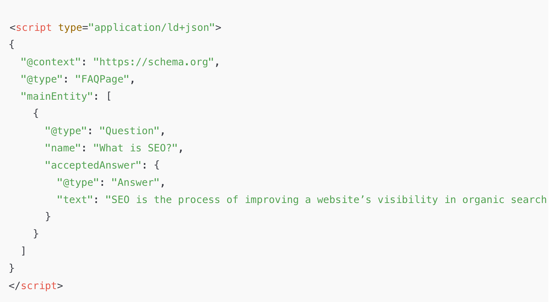
Schema Basics and Relevant Terminology
Everything starts with crawling. As we explain in our latest blog, “How Do Search Engines Work and How Do They Crawl”, search engines rely on crawlers (bots) to systematically discover, access, and download content from web pages. If a bot cannot crawl your website properly, it cannot understand or index your content, regardless of how well it is optimised.
Once content is accessible and crawlable, structured data and schema markup enable search engines to interpret that content in more detail.
Why FAQ Schema Still Matters
Despite the removal of FAQ previews on search result pages, implementing FAQ schema still helps search systems understand the structure and purpose of your content. It can support:
- better interpretation of page content
- improved click‑through rates by presenting question/answer content clearly
- clearer signals for AI search.
The structured data guidelines from Google show that well‑implemented markup helps search engines interpret and index page content more accurately.
When to Use FAQPage Structured Data
FAQ schema should be used only on pages where the questions and their answers are both provided by you and appear clearly in the visible content. Typical use cases include:
- Dedicated FAQ pages
- Product or service pages with clear common questions
- Blogs that address specific user concerns
It should not be used on pages where content is user‑generated, and answers may vary, or where there is no clear question-and-answer structure. Search Engine Land notes that structured data should reflect the actual content visible to users.
How to Implement FAQ Schema
Step 1: Check Suitability
Make sure the page contains actual questions with single, controlled answers. Without this structure, do not apply the FAQ schema.
Step 2: Create JSON‑LD Markup
The following is a simple example of JSON‑LD markup for FAQ schema:
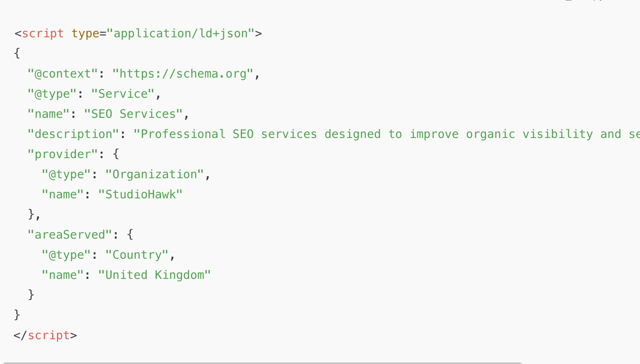
Place this code in a <script type="application/ld+json"> tag on the page.
Step 3: Validate Your Markup
Before publishing, run the structured data through Google’s Rich Results Test to verify there are no errors.
Step 4: Monitor Through Search Console
After deployment, check Google Search Console for any structured data issues and fix them as needed. Search Console provides reports on detected structured data and errors that may affect performance.
FAQ Schema Best Practices
These best practices align with structured data guidance from Google and industry evaluation.-
Ensure Visible Content Matches Schema
Every question and answer in your schema must appear in the page’s visible content. If the page content does not include those questions or answers, do not use the FAQ schema. -
Provide Distinct Answers
Avoid repeating answers or using near‑duplicate text. Search systems interpret unique answers more effectively. -
Apply Schema Only Where Relevant
Do not add the FAQ schema where it does not make sense for the content. Structured data should reflect real user intent. -
Keep Answers Informative and Clear
Answers should directly address the corresponding question with clear, helpful information. -
Regular Monitoring
Search engines update how they use structured data periodically. Use Search Console and validation tools regularly to check for issues.
When Not to Use FAQ Schema
FAQ schema is not suitable for:
- pages where answers come from users and are not controlled by the site owner
- content with multiple valid viewpoints that have different answers
- cases where there is no clear question-and-answer format
In these situations, other schema types such as QAPage or Article may be more appropriate. A QAPage is a WebPage focused on a specific Question and its Answer(s), for example, in a question-answering site or documenting frequently asked questions (FAQs). An article is a type of creative work, such as a news piece of investigative report. It is used to describe textual works published on the web, including blogs, news items, reports, and other article-style content. Schema.org provides definitions for various structured data types.
FAQ Schema and Modern Search
Beyond classic search listings, structured data is increasingly important for AI search and voice interfaces. These systems rely on structured signals to interpret content accurately, identify entities and relationships, and extract concise answers that can be surfaced directly to users. Clear and consistent structured markup helps reduce ambiguity, making it easier for search engines, AI assistants, and LLM-powered tools to understand what a page is about and how its information should be used.
Industry resources highlight that structured data improves clarity across multiple search interfaces, including traditional search results, AI-generated summaries, and voice-based responses. By providing explicit context through schema markup, websites increase their eligibility for enhanced formats such as spoken answers, rich results, and AI-driven experiences, ensuring content can be interpreted and presented accurately wherever users search.
How FAQ Schema Affects SEO Metrics
FAQ schema is not a direct ranking factor, but it affects how content is understood and displayed. It can lead to:
- Greater visibility for question‑based queries
- More accurate interpretation of content by search engines
- Increased likelihood of being cited by AI responses.
Structured data contributes to clearer content signalling in search despite the devaluation of the FAQ preview functionality.
Frequently Asked Questions
What is FAQ schema?
FAQ schema is a type of structured data markup that identifies a set of frequently asked questions and their answers on a page. It uses a standard template from schema.org, most often written as JSON-LD, so search engines can understand the content of the FAQ section without affecting what visitors actually see.
Does FAQ schema still get you a rich result in Google?
Not anymore. Google restricted FAQ rich results to well-known authoritative government and health websites in 2023, and the FAQ rich result feature was totally devalued in May 2026.
Is FAQ schema still useful in 2026?
Despite the removal of FAQ previews on search result pages, implementing FAQ schema still helps search systems understand the structure and purpose of your content. This helps your page be accurately indexed for targeted keywords and helps get your page cited in AI answers.
Will FAQ schema boost my rankings?
FAQ schema is not a direct ranking factor, but it does help search engines interpret and index your content more accurately.
Which pages should carry FAQ schema?
FAQ schema should be used only on pages where the questions and their answers are provided by you and appear clearly in the visible content. It should not be used on pages where content is user-generated and answers may vary, or where there is no clear question-and-answer structure.
How do you implement FAQ schema?
Write the JSON-LD code block while making sure it matches the questions and answers visible on the page. Run it through a schema validation tool to make sure it is parseable. If there are no errors, add the schema to the <head> section of your page's HTML, then monitor Search Console after deployment to make sure no errors arise.
Need expert help with FAQ schema and structured data implementation?
At StudioHawk UK, we go beyond surface-level markup. Our team delivers tailored SEO audits and structured data strategies built around how search engines, AI systems, and users actually interpret content. We help ensure your structured data is accurate, compliant, and aligned with real search behaviour.
The result is clearer signals for search engines and improved visibility across traditional search, AI-driven experiences, and voice interfaces.