If you run a small business in the UK, local SEO is not optional. It is how customers nearby find you when they search for services “near me” or include a town or city name in their query.
Whether you are a solicitor in Leeds, a café in Bristol or a tradesperson in Croydon, location-based optimisation helps you appear in local search results, Google Maps and the all-important local pack. Done properly, it turns visibility into phone calls, form submissions and overall traffic.
In this guide, we break down what local SEO is, why it matters for small businesses, and how to implement it in a structured, commercially focused way.
What Is Local SEO?
Local SEO is the process of optimising your online presence to attract more business from relevant local searches on Google and other search engines. These searches typically include a location modifier such as a town, city, postcode or the phrase “near me”.
According to Google’s own guidance on improving local rankings in its Google Business Profile help documentation, prominence, relevance and distance are the key local ranking factors:
In practical terms:
- Relevance is how closely your business matches what someone is searching for
- Distance relates to how close your business is to the searcher or specified location
- Prominence reflects how well-known and trusted your business appears online
You cannot control a searcher’s location, but you can control how clearly you communicate what you do, where you operate and how credible your business is.
Why Local SEO Matters for Small Businesses
Local intent is high intent. When someone searches for “emergency plumber Manchester” or “best accountant in Reading”, they are looking to solve a problem, often quickly.
Strong local visibility leads to tangible commercial benefits. It increases inbound calls and enquiries, improves lead quality and supports sustainable growth without excessive reliance on paid advertising.
Google continues to prioritise helpful, relevant content and clear signals about business identity.
For small businesses competing against national brands and directories, local SEO provides a realistic and scalable path to growth.
Optimise Your Google Business Profile Properly
Your Google Business Profile is the foundation of local SEO. It directly influences whether you appear in map results and the local pack, which often sits above traditional organic listings.
At a minimum, you should:
- Claim and verify your profile
- Use your exact trading name consistently
- Select the most accurate primary and secondary categories
- Write a clear, service-focused business description
- Upload genuine, high-quality photos
- Keep opening hours and contact details up to date
Reviews are particularly important. Consistently asking satisfied customers for feedback and responding professionally to all reviews strengthens both visibility and trust. Treat your profile as an active asset, not a one-time setup.
Create Location-Specific Service Pages That Add Value
One of the most common local SEO mistakes is trying to rank a single generic service page for multiple towns. If you genuinely operate across several areas, you need dedicated landing pages for each core location.
Google is clear about avoiding low-value or duplicate content in its search spam policies.
Each location page should clearly explain the services available in that area, demonstrate local experience through testimonials or case studies, and provide practical coverage information such as response times or service radius.
Avoid copying and pasting the same content and simply swapping out the location name. That approach rarely performs well long-term and can dilute overall site quality.
Get Your NAP Consistency Right
NAP stands for Name, Address and Phone number. Inconsistent business details can weaken trust signals and dilute your local visibility.
Search engines cross-reference your information across the web. To maintain consistency, ensure your details match exactly across your website, Google Business Profile, Companies House listings where relevant, and trusted industry or regional directories.
Even small variations in formatting can create confusion. Standardise your details and apply that format everywhere.
Build Local Citations and Relevant Links
Citations are mentions of your business details on other websites, while backlinks are clickable links pointing to your website. Both contribute to local authority and prominence.
For UK small businesses, high-quality local signals often matter more than volume. Examples include:
- Membership listings with local chambers of commerce
- Coverage in regional news publications
- Partnerships or sponsorships within your community
Digital PR and Local Relevance
Digital PR nurtures the importance of contextual relevance in link-building strategies by earning coverage and backlinks that are genuinely aligned with your industry, audience and expertise. Rather than acquiring links from unrelated directories or generic websites, Digital PR focuses on placing your brand within relevant publications, trade media and authoritative platforms that naturally sit within your niche. This contextual alignment strengthens how search engines interpret your authority and topical relevance, which is increasingly important as Google prioritises quality and intent over volume.
When a cybersecurity firm, for example, earns links from technology publications or business news outlets covering data protection, those signals carry far more weight than random placements. In short, Digital PR does not just build links. It builds the right links, in the right context, supporting sustainable organic growth rather than short-term gains.
Focus on links that reflect genuine community presence rather than bulk directory submissions or low-quality placements.
Optimise for Local Keywords With Commercial Intent
Local keyword research should reflect how people in your area actually search. That includes service and location combinations, postcode searches and urgent problem-based queries.
For example, searches such as “employment solicitor Sheffield”, “boiler repair SW19” or “SEO agency in Brighton” signal clear commercial intent.
Tools such as Ahrefs and Semrush provide structured approaches to identifying and evaluating search demand.
Prioritise keywords with strong intent and map them carefully to specific pages so that each page has a distinct, focused purpose within your site architecture.
Add Local Structured Data
Structured data helps search engines interpret your business information more accurately. Implementing LocalBusiness schema markup reinforces your core details, including name, address, phone number and opening hours.
For example, if a recipe page includes JSON-LD structured data outlining the recipe’s title, author, ingredients, cooking time and nutritional information, Google can interpret those individual elements clearly. As a result, it may display the page as a rich result in search, showing enhanced features such as star ratings, cooking time or calorie count directly in the search listing.
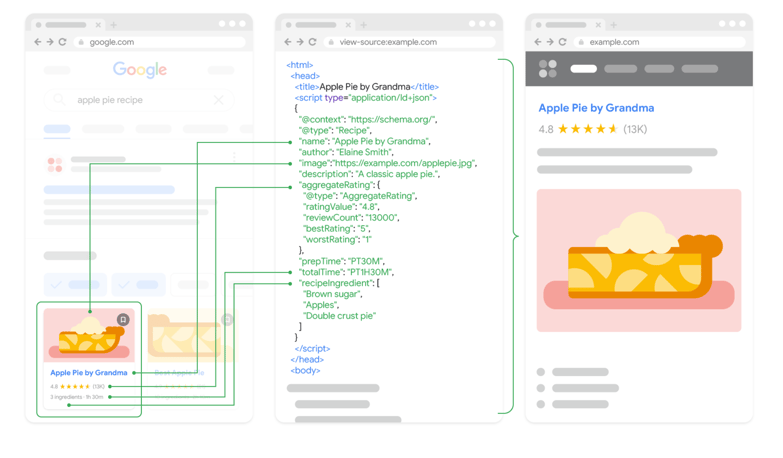
Because each component of the recipe is labelled within the structured data, users can also find the page through more specific searches, such as queries by ingredient, preparation time or calorie level. Structured data therefore, helps Google connect detailed page information with relevant user searches, improving visibility and search experience.
While structured data alone will not drive rankings, it strengthens clarity and supports the consistency of your local SEO signals.
Create Locally Relevant Content
Local SEO extends well beyond optimised service and location pages. Publishing genuinely region-specific content strengthens your authority within your service area, deepens topical relevance and supports sustainable, long-term visibility.
This might include commentary on local regulations affecting your industry, guides tailored to specific towns or postcodes, and case studies featuring nearby clients. However, the difference between average and high-performing local content lies in specificity.
Rather than simply inserting a town name into a generic article, focus on real local insight. Reference council policies, regional statistics, infrastructure developments or market conditions that directly impact your audience. For example, a property firm could analyse how planning restrictions in a particular borough affect homeowners, while a trades business might address common building issues in Victorian terraces across a specific postcode district.

Case studies are particularly powerful in this context. By clearly outlining the client’s location, the challenge they faced, the solution you implemented and the measurable outcome, you demonstrate genuine on-the-ground experience. This builds trust with prospective customers and reinforces geographic relevance signals to search engines.
Locally relevant content also strengthens your internal linking strategy. Blogs focused on specific towns can link naturally to related service and location pages, creating a clearer site structure and reinforcing keyword themes.
Google prioritises content that demonstrates first-hand expertise, delivers meaningful insight and genuinely helps users solve problems. When your content answers real questions for real people in a defined area, you are not just optimising for rankings. You are building authority, credibility and long-term local visibility.
Ensure Your Website Is Technically Sound
Local optimisation cannot compensate for technical weaknesses. Your website must be mobile-friendly, secure and fast-loading to compete effectively.
Many local searches happen on mobile devices. If your website does not perform well on mobile, potential customers will leave and choose a competitor.
Final Thoughts: Local SEO Is a Long-Term Asset
Location-based optimisation is not a one-off task. It is an ongoing process of maintaining accuracy, strengthening authority and improving relevance within your service area.
For small businesses in the UK, strong local SEO levels the playing field against larger competitors. When executed properly, it delivers consistent, high-intent enquiries and reduces reliance on paid acquisition channels.
The businesses that win locally are not necessarily the biggest. They are the most consistent, the most credible and the clearest about what they do and where they operate.
Need help growing your organic traffic?
If you're unsure where to begin or want expert support to build a content strategy that actually delivers results, speak to the team at Studiohawk. We'll help you create and maintain content that remains relevant, useful, and optimised for long-term growth.
Contact our SEO experts today.
Book a free consultation and see what’s possible!