TL;DR
- AI search sends little traffic and big orders. Across 100 Australian ecommerce brands over 21 months, we tracked about A$700,000 of revenue from AI search, and the largest orders came from high-consideration categories.
- It runs on the SEO foundations you already fund. AI visibility is a layer on top of SEO, with no separate product needed.
- Fund fundamentals, content and digital PR. Ask anyone selling a standalone "AI search product" to show a measurable outcome first.
Someone on your board asked about your AI search strategy, and the room went quiet. AI search is real and still early, and the right response costs less than the hype suggests.
The board needs a clear read of the data and one or two decisions, and the budget can stay calm.
We pulled 21 months of data across 100 Australian ecommerce brands, July 2024 to March 2026, across every channel. This is what that data says.
Does AI Search Matter If It Sends So Little Traffic?
AI search matters because the little traffic it sends buys the expensive things.
Across 100 brands over 21 months, we tracked about A$700,000 in revenue attributed directly to AI search, mostly ChatGPT, from roughly 340,000 sessions. As a share of total revenue, that is a rounding error. Reallocating the marketing budget around it tomorrow would starve the channels that pay the bills.
The value of each visit is where it gets interesting.
People who arrive from ChatGPT tend to buy bigger. In the high-ticket categories, revenue per AI-referred session ran many times higher than the Google organic average.
The headline average hides that. Across all brands, ChatGPT's average order value (around A$220) only just beats Google organic (around A$215). The gap sits in expensive, high-consideration products, and that is the pattern to take to the board.
The High-Ticket Effect: Where AI Actually Sends Revenue
AI search revenue concentrates in the categories where buyers research hard before they spend.
In our data, AI-referred orders in high-consideration categories such as furniture and home appliances were worth far more than the typical organic basket. The bigger and more considered the purchase, the more AI search punches above its weight.
The reason is timing. Someone who types "what's the best sofa bed under £1,000 in the UK" into ChatGPT is near the end of their journey. The AI has already read the reviews, compared the specs and weighed the price, so the comparison shopping that normally spans a dozen browser tabs is done. For a high-ticket product, the hardest part of the sale has happened before the visit.
Conversion rate (the share of visits that end in a sale) tells a different story from order value, and both are normal. Premium furniture converted slowly from ChatGPT, as you expect from a considered purchase. Home appliances, a faster decision, converted far more often.
For a CMO, the takeaway is to make sure that when AI sends a high-intent buyer, your page closes the sale.
This video walks through why ecommerce sites lose AI search sales, and what fixes it.
It Runs on the SEO You Already Fund
Most of what wins AI search is the SEO work you already fund.
AI tools search the same web your SEO already targets. ChatGPT search draws heavily on Bing's index. Google's AI Overviews (the AI-written summaries above the results) and AI Mode (Google's chat-style search) run on Google's own results. When an AI system decides which brands to mention, it uses the same signals that decide who ranks: strong technical foundations, useful content and authority across the web.
That makes GEO, AEO and whatever the acronym is this quarter a layer on top of SEO.
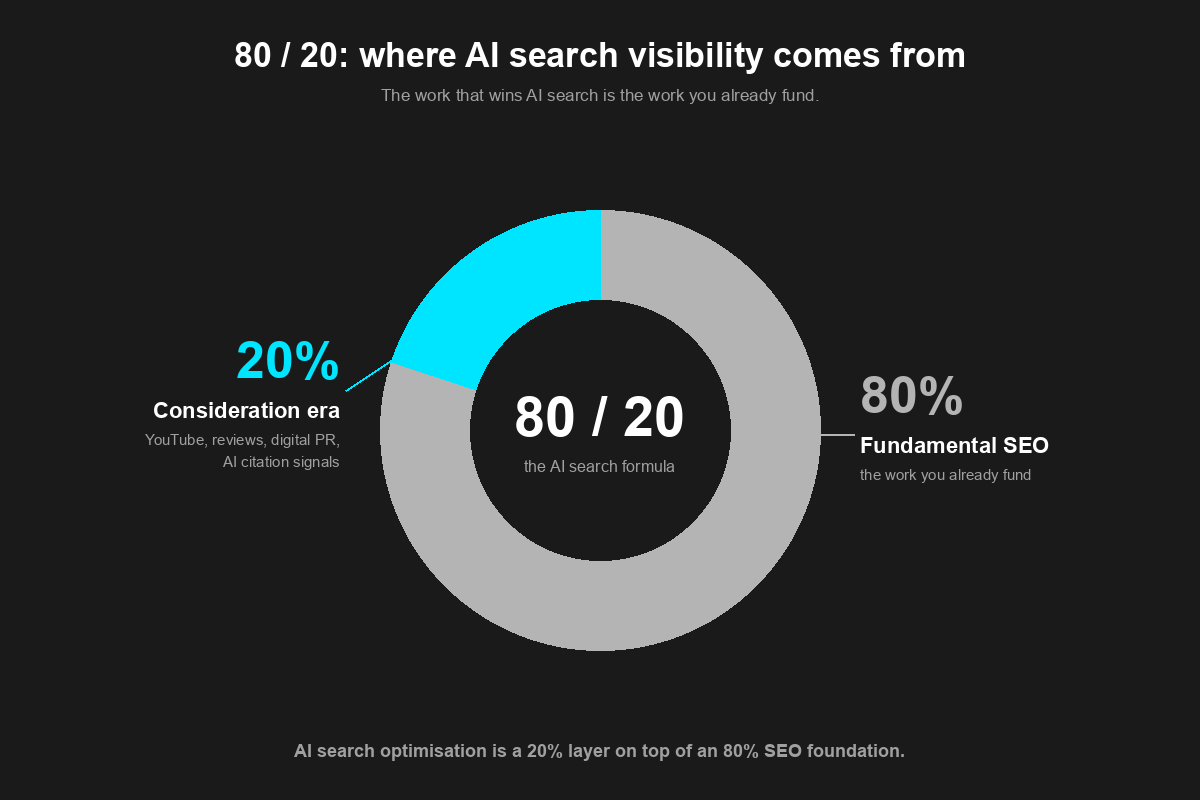
The 20% on top is consideration era work: showing up in the places AI models draw on when they make recommendations. That means YouTube, Reddit, Trustpilot and other review platforms, podcasts, and earned media through digital PR. It matters, and it works once the 80% underneath is solid.
What Do the Winners Do?
The brands winning high-ticket AI orders have product pages that answer a buyer's questions as well as asking for the sale.
When AI hands a buyer a shortlist, it favours pages it can read: clear product specs, visible pricing, structured data (code that labels a page's facts for search engines and AI tools) and answers to the questions a buyer actually asks. Thin pages built only to push "add to cart" give the AI little to work with, and they lose the high-intent visitor when the AI sends one.
For Hush Puppies in Australia, we rebuilt product and collection pages with clearer structure, sizing content and product structured data. Product page revenue rose 45%, product page users rose 29%, and top-three rankings for non-branded keywords grew 150%. The same work makes a page easy for AI to read: a buyer and a machine can both pull out what matters.
It is product pages done properly, which is why it pays off in Google and AI search at the same time.
Where Should You Put the Money?
Fund the foundations, and ask any vendor selling a separate AI search retainer to prove a measurable outcome first.
The market is filling with vendors selling a standalone "AI search" or "GEO" retainer on top of the SEO you already pay for. In most cases they charge you twice for overlapping work. Before you sign, ask for a measurable outcome. A vendor who has one will show it.
| Fund this | Be sceptical of |
|---|---|
| Technical foundations | A separate "GEO" or "AI search" product on top of existing SEO |
| Product pages built to answer buyer questions | Tools that promise to trick or game AI |
| Digital PR and brand authority | Anything with no measurable outcome |
| Proper measurement (the AI Assistant channel in Google Analytics 4, plus Search Console, Google's report of the searches you appear in) | Panic spend driven by one board meeting |
Owned search is still the asset that compounds. Paid ads are rented traffic, and the rent rises every year. The brands that invest in owned visibility now are the ones AI will recommend in two years, for a fraction of the ongoing cost.
The budget question is whether the line items you already have are strong.
Four Questions to Ask Your Team This Quarter
Ask your team these four questions and listen closely to the answers.
- Are we measuring AI search traffic? GA4 (Google Analytics 4) added an AI Assistant channel in May 2026 that groups visits from ChatGPT, Gemini and Claude automatically. It misses some smaller AI tools, so treat the number as a floor. Your team should be able to show you that number.
- Are our high-ticket product pages built to close? For your most considered products, check for visible pricing, structured specs and answers to real buyer questions. That is what converts the high-intent visitor AI sends.
- When buyers ask AI about our category, do we show up? Ask your team to run the questions your customers ask ChatGPT, Perplexity and Gemini, and report back on where you appear and which competitors appear instead.
- Is anyone selling us a separate AI search product? If so, ask them to prove a measurable outcome. Good vendors welcome the question.
A team that can answer all four clearly puts you ahead of most boards asking the same question this quarter.
What Should the Board Take Away?
AI search sends little traffic and outsized orders, and it runs on the SEO foundations you already fund.
The brands winning it have product pages that answer buyer questions and authority earned across the web. Fund the fundamentals, sharpen your high-ticket pages, measure properly, and question anyone selling a panic-priced AI search product on the side.
That answer is calm, and a lot cheaper than the alternative.
FAQ
What is AI search and how is it different from SEO?
AI search is when tools like ChatGPT, Perplexity, Google AI Overviews and Gemini answer a question directly and cite or recommend brands, in place of a list of blue links. It runs on SEO: these tools draw on the same search indexes and ranking signals, so strong SEO is what gets you cited.
Do we need a separate AI search or GEO strategy?
For most brands, no. GEO, AEO and AI search optimisation are a layer on top of solid SEO. The smarter move is to strengthen your fundamentals and add consideration era work like digital PR, and skip any standalone product that overlaps with your existing SEO.
How much revenue does AI search actually drive right now?
In our study of 100 Australian ecommerce brands over 21 months, AI search drove about A$700,000 in directly attributed revenue. The volume is small, but it skews toward expensive, high-consideration orders, so in high-ticket categories each AI visit can be worth far more than an organic one.
How do we measure AI search traffic?
GA4 added an AI Assistant default channel in May 2026, so visits from ChatGPT, Gemini and Claude are grouped automatically. It misses some smaller AI tools, so treat the figure as a floor. Combined with Search Console, it shows AI-referred sessions and the pages that earn them.
Should we cut our SEO budget to fund AI search?
No. AI visibility depends on the same foundations as organic search, so cutting SEO to chase AI search weakens both. Fund the fundamentals first, then add the consideration era work that helps AI systems find and trust you.
Further reading
- What is AI SEO?: the discipline behind AI search visibility.
- AI SEO metrics: how to measure AI search on your own site.
- Format Leverage: our study of which content formats earn AI search traffic.
Get a Clear Read on Your AI Search Position
If you want to know where your brand sits in AI search and what to fund next, request an SEO and AI Masterplan. And if your team wants to skill up for free, send them to Hawk Academy.
Sources
- Search Engine Journal, Google Analytics adds AI Assistant as a default channel group, May 2026. searchenginejournal.com
- Search Engine Journal, GA4's AI Assistant channel undercounts your AI traffic. searchenginejournal.com