Every "what to build for AI search" list puts comparison pages at the top.
We looked at 1.2 million AI referral sessions (visits sent to a website by an AI assistant) across more than 500 businesses and found something different.
This is what we'll cover in this blog:
- What content formats earn the most AI search traffic?
- What is the AI traffic leverage ratio?
- Why do interactive tools and calculators win AI citations?
- What makes content “answer-shaped”?
- Do comparison pages deserve their reputation in AI search?
- Where does AI referral traffic actually land?
- Which content format is the most reliable?
- What should you build first for AI search?
- Does the winning format change by industry?
- How we measured this
- The experience we've had in AI search
- FAQ
TL;DR
-
Interactive tools and templates earn 7.5 times their share of pages in AI referral traffic, the highest ratio of any content format we measured across the websites of more than 500 businesses.
- Comparison pages, the format most often recommended for AI search, ranked 5th of 7 formats in our first-party data.
- A third of all AI referral traffic lands on product and collection pages. AI assistants are already a buying channel, and your commercial pages are already in the answer set.
The content that earns the most AI search traffic per page is the humble calculator.
Across the websites of more than 500 businesses and 1,203,748 real visits referred by ChatGPT, Gemini, Perplexity, Claude and Copilot, interactive tools and templates earned 7.5 times their share of pages, the highest of any content format we measured.
Most advice about AI search is built on citation counts scraped from the outside.
This study is built the other way: first-party analytics from the websites of more than 500 businesses in our own analytics data, measuring the AI referral visits that actually arrived.
We ranked every format by one number, the AI Traffic Leverage Ratio.
That ratio is the reason our conclusions differ from the citation-counting studies you have already seen.
What content formats earn the most AI search traffic?
Interactive tools, templates and calculators earn the most AI search traffic relative to their supply: 7.5 times their share of pages.
How-to content follows at 5.65, definitions at 5.41, listicles at 5.09, comparison pages at 4.44, guides at 4.17 and statistics pages last at 2.52.
The table below shows every content format in the study, the number of sites publishing it, the AI referral sessions it earned, and its ratio.
| Content format | Example (from our own site) | Sites with the format | AI referral sessions | Ratio |
| Tools, templates & calculators | SEO ROI calculator | 217 | 1,845 | 7.54 |
| How-to content | How to rank in ChatGPT | 436 | 5,744 | 5.65 |
| Definitions and concept explainers | What is AI SEO | 303 | 2,049 | 5.41 |
| Listicles (top X, best X) | Top 5 content strategies for SaaS | 318 | 2,213 | 5.09 |
| Comparison pages (X vs Y) | Enterprise SEO vs traditional SEO | 208 | 791 | 4.44 |
| Guides | Complete guide to technical SEO | 293 | 1,919 | 4.17 |
| Statistics and data pages | Enterprise SEO statistics | 146 | 224 | 2.52 |
Source: StudioHawk Format Leverage study, more than 500 businesses, January to July 2026
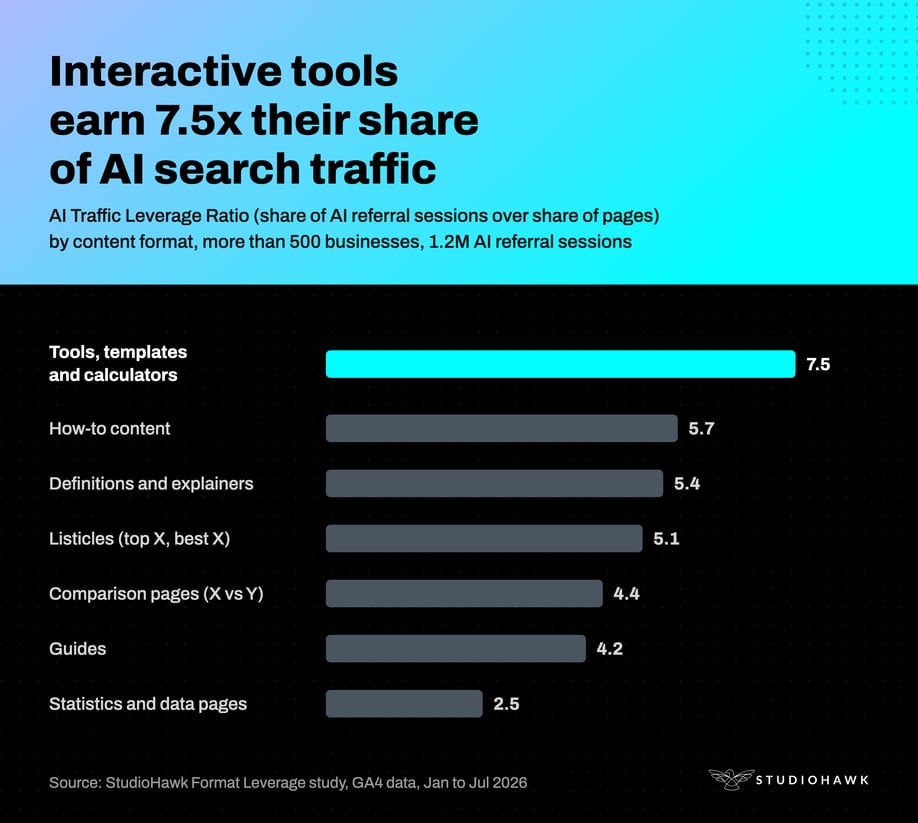
AI Traffic Leverage Ratio by content format
Every format sits above 1.0, meaning every content format out-earns its share of pages in AI referrals.
The spread between the top and bottom formats is threefold, so the format you choose changes the result.
Reading that lever correctly depends on the ratio behind the ranking.
What is the AI traffic leverage ratio?
The AI Traffic Leverage Ratio is a format’s share of AI referral traffic divided by its share of published pages.
A ratio above 1.0 means the format earns more AI traffic than its page count predicts.
Below 1.0 means it is oversupplied relative to what it earns.
The normalisation is the point.
Raw citation or traffic counts reward whatever there is most of.
Product pages earned more total AI sessions than every content format combined, but there are also vastly more of them.
Divide traffic share by page share and you see what each page type earns per unit of effort.
That supply adjustment is what most AI search studies skip.
Counting citations tells you what appears in answers most often.
The ratio tells you what one more page of each format is worth, which is the question that decides what you build next.
By that measure, the first thing to build is the format at the top of the table, the interactive tool.
Why do interactive tools and calculators win AI citations?
Interactive tools and calculators win because they are scarce, answer-shaped and liftable.
This video walks through the six steps we use to make content that Google and AI tools cite.
When someone asks an assistant “how much does X cost” or “what size Y do I need”, a calculator page is the exact object that resolves the question.
Few sites have one, so the ones that exist collect outsized referrals.
Across our dataset, 217 websites had at least one tool, template or calculator page.
Those pages made up a fraction of one percent of all pages we analysed, yet they earned 7.5 times their share of AI referrals.
The pages driving this number are cost calculators, sizing and quantity estimators, downloadable checklists and template packs, the kind of asset a content team ships in a two-week sprint.
Fewer than one in five websites in the study has even one.
That scarcity, more than any structural trick, is the moat.
Measure your own site against the study with the calculator below.
Enter a format’s page count and AI referral sessions alongside your site totals, and it returns your AI Traffic Leverage Ratio benchmarked against the study.
AI traffic leverage calculator
Ratio = your format's share of AI referral sessions divided by its share of pages.
Above 1.0 means the format earns more than its supply.
Pull the four numbers from GA4 (sessions where the source is an AI assistant) and your CMS or a site crawler (a tool that lists every page on your site).
Benchmarks: StudioHawk Format Leverage study, more than 500 businesses, 1.2M AI referral sessions, Jan to Jul 2026.
AI referrers under-report, so treat results as floors.
What makes content “answer-shaped”?
Answer-shaped content resolves a query in one artefact: a calculator that outputs the number, a template that is the deliverable, a definition that is the answer (our explainer on what is AI SEO is that shape).
The pattern holds across the top of our ranking.
Tools, how-tos and definitions all package a complete answer in a single page, and all three score above 5.4.
The formats lower on the table make the reader do the assembly.
That gap between packaged answers and assembly-required content is clearest in the format everyone keeps recommending: the comparison page.
Do comparison pages deserve their reputation in AI search?
Comparison pages perform well, but four formats beat them.
At a ratio of 4.44 they ranked 5th of 7 content formats, behind listicles, definitions, how-tos and tools.
That result contradicts a lot of current advice.
Comparison content is the most recommended AI search play of 2026, usually on the logic that “X vs Y” pages face little competition and match high-intent questions.
Our first-party data says the logic is half right: comparison pages out-earn their page share, so they are worth having.
It also says four other formats out-earn them per page.
“The pattern we keep seeing is programmatic: hundreds of pages built on one idea.
Our data shows AI assistants reward seven different formats.
One idea only ever captures one of them.”
Lawrence Hitches, Chief of Staff, StudioHawk
The gap between reputation and measurement matters because teams are re-prioritising roadmaps around it.
Part of the explanation sits in supply: comparison pages stopped being scarce.
Two years of “build vs pages” advice produced a wave of them, and our dataset shows 208 websites in the study now publish comparison content.
Scarcity is a moving target, and the formats that score highest today are the ones most sites have yet to build.
Before you re-prioritise anything, though, the next question is where AI referral traffic actually goes.
Where does AI referral traffic actually land?
A third of all AI referral traffic lands on product and collection pages.
Another 56 percent lands on homepages, service pages and other brand and entity pages.
Content formats and everything else share the remaining 11 percent, with the formats themselves at about 3 percent.
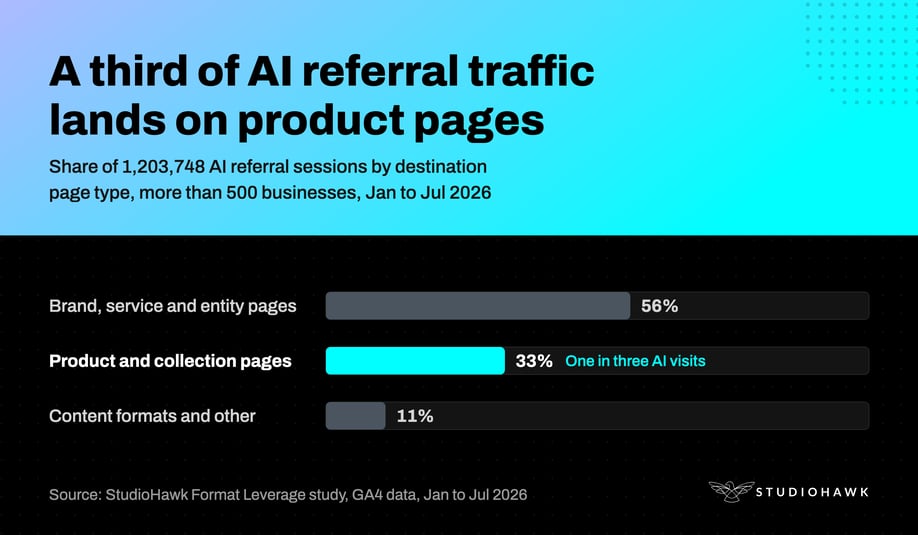
Where AI search traffic lands
Source: StudioHawk Format Leverage study, more than 500 businesses, January to July 2026
Read those two numbers together and the story is blunt: AI assistants are already a buying channel.
They answer research questions, and they also hand users straight to commercial pages.
Product pages scored 2.41 in our data, above break-even, which means even relative to their enormous page counts they over-earn.
For eCommerce brands this is the single most actionable finding in the study.
Your product and category pages are already in the AI answer set, and ecommerce SEO fundamentals like clean product data, schema (code that labels a page for search engines) and crawlability decide how often.
Commercial pages take the volume. One content format stayed above break-even in every sub-portfolio.
Which content format is the most reliable?
Guides are the most reliable format in the study.
We split the dataset into six sub-portfolios and re-ran the analysis on each.
Guides were the only content format above break-even in all six.
Every other format, including the tools at the top of the pooled table, dropped below 1.0 in at least one sub-portfolio.
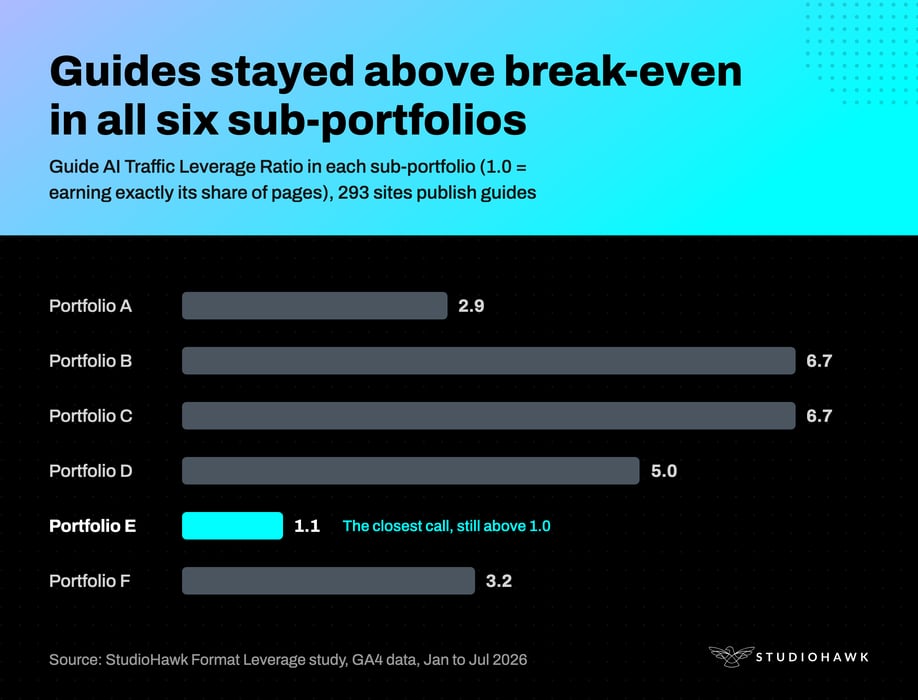
Guide ratio across six sub-portfolios
Source: StudioHawk Format Leverage study, more than 500 businesses, January to July 2026
Magnitude and reliability are different bets.
Tools deliver the highest ceiling; guides deliver the safest floor.
A portfolio answer beats a single-format answer, which is exactly how we would build it.
What should you build first for AI search?
Build an interactive tool first.
Here is the full order we would build in, leading content for a brand right now:
- Ship one interactive tool this quarter. A calculator, configurator or template generator in your highest-value topic. Highest ratio in our data (7.54) and the least crowded, because few competitors ship tools.
- Cover your entity’s how-to and definition set completely. The workhorse formats (ratios of 5.65 and 5.41) that answer the questions assistants field all day. Structure them so the answer leads, per our guide to ranking in ChatGPT.
- Keep comparison pages in the mix, proportionally. They earn 4.44 times their share. Build the matchups your buyers actually ask about.
- Anchor each cluster with a guide. The only format that held above break-even everywhere we looked. The safe core of a topic cluster.
- Treat commercial pages as AI surfaces. A third of AI referrals land on them. Product data quality, schema and page speed are now AI visibility work as well as technical SEO.
- Deprioritise standalone statistics pages, which came last at 2.52. Yes, we see the irony: this page is one. That is why this study ships with a ranking table, three charts and a what-to-build list you can lift.
How far you weigh each step depends on your industry, and that dependence turned out to be the study’s biggest surprise.
Does the winning format change by industry?
Yes, and by more than we expected.
When we split the dataset into sub-portfolios, format returns swung by roughly 10 times depending on the mix of businesses.
Tools topped some segments and fell below break-even in others.
Comparison pages ranged from parity to a 10.87 peak.
The pooled ranking above is the honest portfolio-wide answer, and it is also an average across industries that behave very differently.
The per-industry cut, which formats win in eCommerce versus services versus B2B, is the next release in this series.
It feeds directly into our AI SEO service work.
How we measured this
-
Dataset.
We took the GA4 website properties of more than 500 businesses in our own analytics data (spanning ecommerce, services, B2B, health, legal and education), classified all 7.5 million pages into a content-format taxonomy, and measured the 1,203,748 AI referral sessions those pages earned.
Many businesses run multiple websites (regional domains, apps, sub-brands), all from our own analytics data.
- Window. 15 January to 14 July 2026. Six months, one fixed snapshot, dated and frozen.
- Sources. A session counts as AI referral traffic when its recorded source is ChatGPT, Gemini, Perplexity, Claude or Copilot. Classic Bing search traffic is excluded. Google AI Overview clicks arrive as standard Google organic in analytics, so they are excluded.
- Classification. Every page was classified into a format taxonomy by a rules engine, then hand-validated on stratified samples. The classifier scored 91.7 percent format accuracy on a held-out sample of new sites. Remaining errors mix up neighbouring formats, such as a guide read as a how-to, and commercial pages stayed out of the content buckets.
- Privacy. All figures are anonymised aggregates, and no business can be identified. No cut in this report rests on fewer than five separate websites, enforced in code.
- Limits. The data shows correlation, and cause is unproven: high-ratio formats attract AI traffic, and strong sites also tend to build those formats. Figures are undercounted wherever assistants strip referrer data, so treat every figure here as a floor. The ratio compares formats on the same measurement, so the undercount leaves the ranking unchanged.
The experience we've had in AI search
StudioHawk has run 2,000+ campaigns since 2015. Our AI search programmes range from ecommerce brands tracking assistant-referred revenue to B2B firms rebuilding content clusters around answer-shaped formats.
This study exists because that portfolio gave us measurement access no citation-scraping study can match.
FAQ
What content format earns the most AI search traffic?
Interactive tools, templates and calculators earn the most AI search traffic per page, at 7.5 times their share of pages across the websites of more than 500 businesses in StudioHawk’s Format Leverage study. How-to content (5.65) and definitions (5.41) follow.
How do you measure AI search traffic in GA4?
AI search traffic in GA4 is measured by filtering sessions on source: chatgpt.com, gemini.google.com, perplexity.ai, claude.ai and copilot.microsoft.com referrers. Referrer stripping means the result undercounts true AI traffic, so treat any figure as a floor.
Do comparison pages work for AI search?
Comparison pages work for AI search, earning 4.44 times their share of pages in AI referrals. They ranked 5th of 7 content formats in our data, so they belong in the mix, below tools, how-tos, definitions and listicles.
How much traffic do AI assistants send to websites?
Across the websites of more than 500 businesses over six months, AI assistants referred 1.2 million sessions, with a third landing on product and collection pages. Figures are undercounted wherever assistants strip referrer data, so treat them as floors.
Further reading
- How to rank your website on ChatGPT: structure the how-to and definition pages this study ranks near the top.
- What is AI SEO?: the discipline these formats feed.
- AI SEO metrics: how to measure AI search traffic on your own site.
Find the formats that earn your AI traffic
We measure which content formats earn AI search traffic on your site, then build the ones that pay. Talk to our AI SEO team.