TL;DR
- AI SEO is the work of getting your brand cited in AI answers from ChatGPT, Gemini and Google's AI Overviews and AI Mode. It can also mean using AI tools to do SEO.
- It runs on SEO foundations. Across more than 500 websites in our analytics data, pages with readable URLs got about 13 times more AI visits per page.
- What AI SEO adds is reach beyond your own site: off-site platforms, digital PR, entity work and content built to be quoted.
- AI SEO is SEO done well, plus the work that gets AI systems to mention you when your customers ask them for advice. Google put the first half on a slide: "Good SEO is good GEO."
- Our own campaigns show the second half is where the AI winners differ. That second half is new, and it is where most brands are behind.
- AI Mode has been live in the UK since 28 July 2025, and ChatGPT now sends more referral traffic to UK websites than every other AI assistant combined. The question your customers used to type into Google, they now ask a chatbot. If the chatbot does not know you, you are not in the answer they give back to users.
In this short video, Harry Sanders explains what AI search is and what it means for your business.
What is AI SEO? (explained simply)
AI SEO is the practice of making your brand the source an AI system chooses when it answers a question in your category.
The goal is to be mentioned, cited and linked in AI-generated answers, as well as ranking in the blue links.
The term has a second meaning. Plenty of people search "ai seo" when they mean using AI tools to do SEO work: clustering keywords, writing briefs, running audits.
Both are real, and we cover the second one further down.
This article is mostly about the first.
You will also see a pile of acronyms for the same work:
Term | What people mean by it |
AI SEO / AI search optimisation | Getting cited and recommended in AI answers |
GEO (generative engine optimisation) | The same thing, named after generative AI |
AEO (answer engine optimisation) | The same thing, named after "answer engines" |
LLMO (large language model optimisation) | The same thing, named after the models |
All four labels describe the same work.
We call it AI search, because that is what your customers are using.
What Is GEO? Generative Engine Optimisation Explained
As we cover in our deeper guide on what Generative Engine Optimisation (GEO) actually is, true GEO content relies heavily on SEO fundamentals. Generative engine crawlers find your content so it can be cited or linked to by authoritative third-party sources. It answers questions directly and completely.
Whatever the label, the work starts with SEO, whether you call it AI SEO, GEO or AEO.
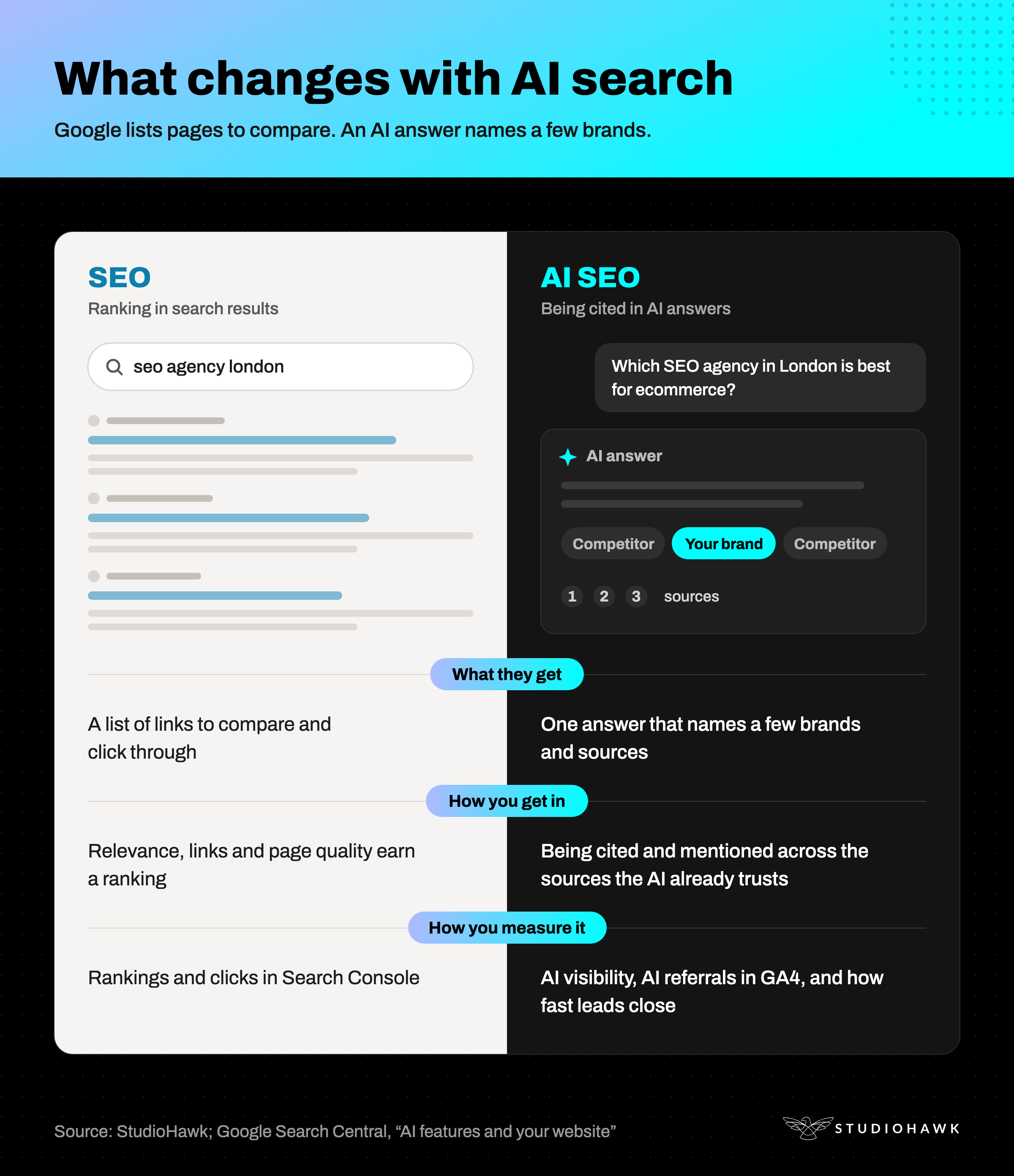
Source: StudioHawk
Is AI SEO different from SEO?
AI SEO is not different from SEO at the foundations.
You cannot do AI SEO without solid SEO underneath it.
Google's guide to optimising for AI features (last updated 10 July 2026) says those features are "rooted in our core Search ranking and quality systems." The guide explicitly calls optimising for them "still SEO."
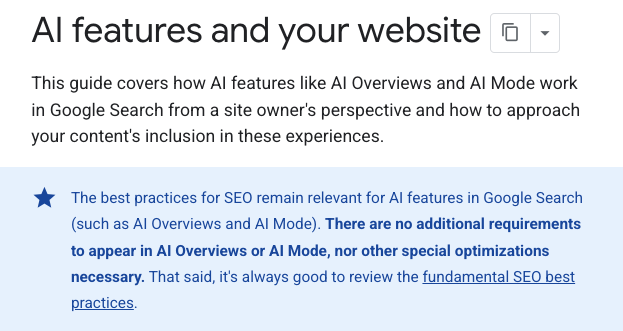
It also sets a clear entry requirement. To appear in an AI feature, "a page must be indexed and eligible to be shown in Google Search with a snippet."
Google has said the same thing on stage and in writing. "Good SEO is good GEO" has been a consistent message from Google, including from John Mueller, Search Advocate:
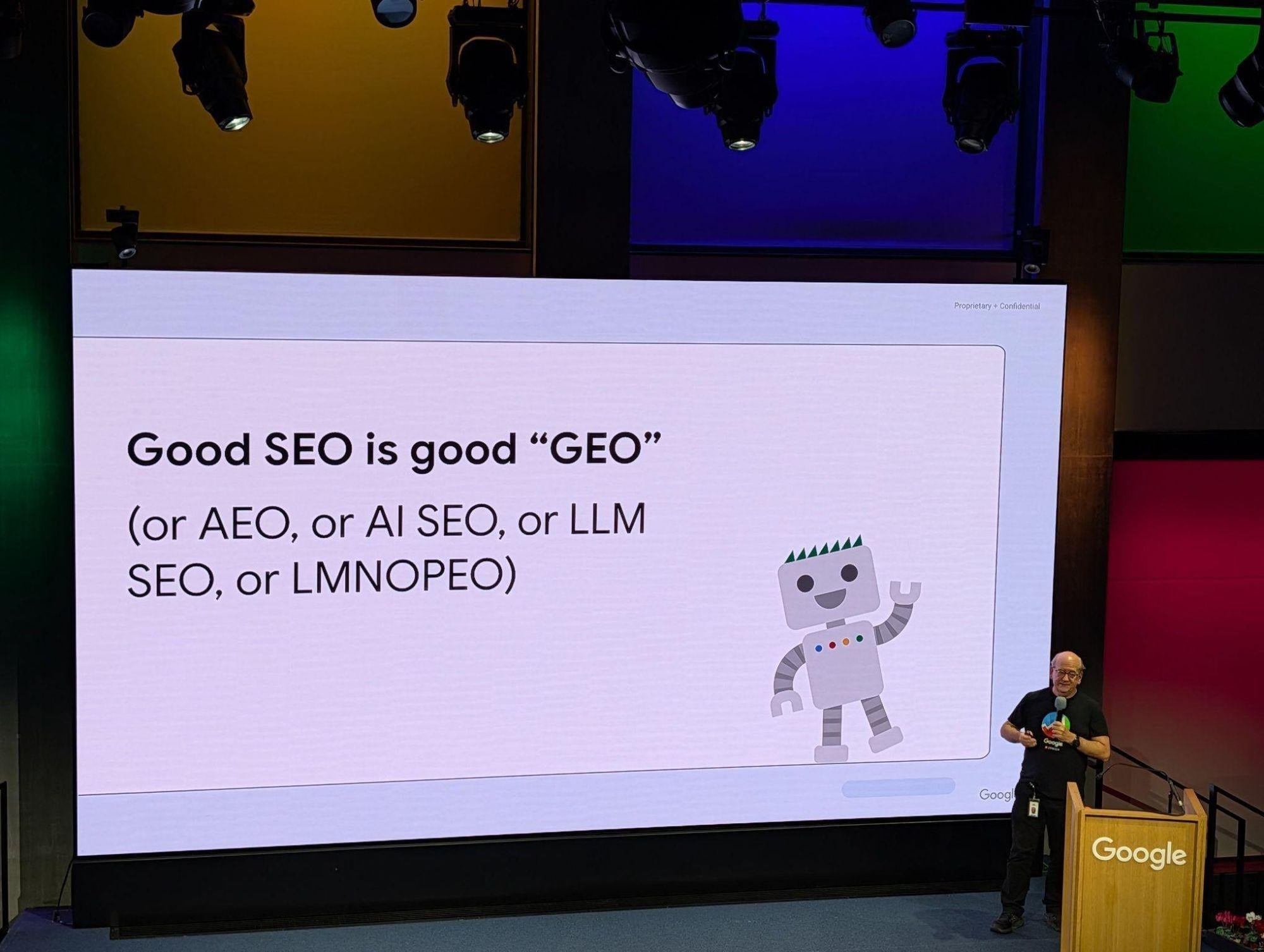
That's why we say AI SEO starts with SEO. Google has confirmed that AI search fundamentals are still SEO fundamentals.
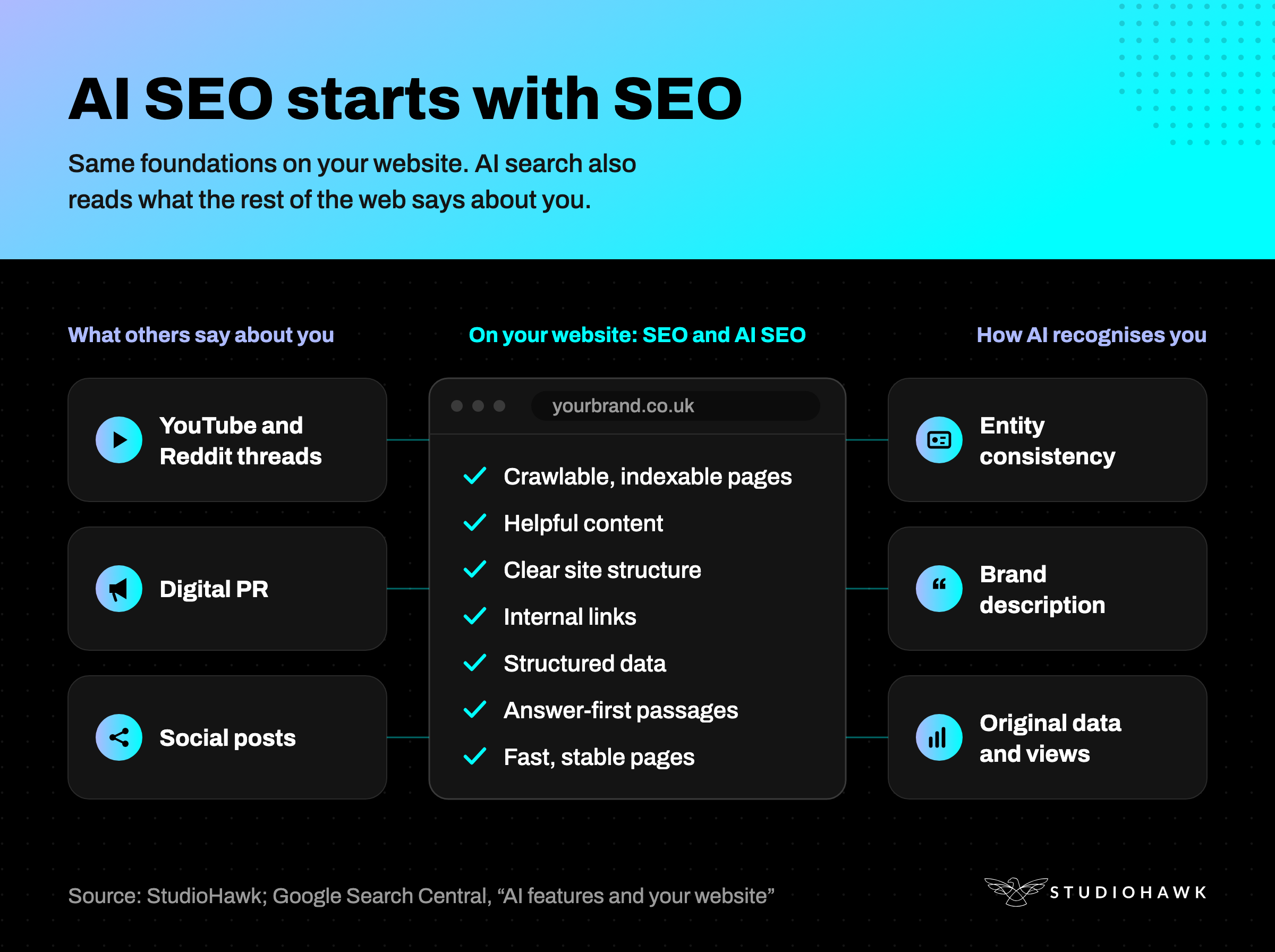
What changes is the weighting. Some things matter more when the reader is a language model:
Stays the same | Matters more for AI search |
Crawlable, indexable, fast pages | Being mentioned on the sites AI systems cite most (YouTube, Reddit, Wikipedia, LinkedIn) |
Clear site architecture and internal links | Digital PR and high-authority links that put your name in trusted sources |
Helpful content that answers the query | Content structured so a single passage can be quoted on its own |
Structured data | A consistent description of who you are, everywhere your brand appears |
Earning links | Original data and opinions nobody else can publish |
Do SEO first, then AI SEO. Our campaign data below shows why.
What does our data show about AI search?
We run first-party studies across our client base because most AI search advice is opinion.
Three findings from that work all point back at SEO fundamentals.
1. Tools and templates earn 7.5 times their share of AI traffic:
Interactive tools and templates earned 7.5 times their share of pages in AI referral traffic, the highest of any format. That is across the websites of 500+ businesses and 1.2 million AI referral visits from ChatGPT, Gemini, Perplexity, Claude and Copilot, as detailed in our Format Leverage study.
January to July 2026: Comparison pages, the format most often recommended for AI search, came 5th of 7. And a third of all AI referral traffic landed on product and collection pages.
The popular AI SEO advice does not match what AI actually sends traffic to.
2. AI sends the expensive, considered purchases:
In our study of 100 Australian eCommerce brands, AI-referred customers buying furniture, appliances, fitness equipment and jewellery placed orders worth A$900 to A$2,500. Winning those buyers takes product pages with visible pricing and structured specifications. That is ordinary SEO work, and it lines up with the high-ticket effect we see in AI search.
3. Readable URLs get about 13 times more AI visits per page:
Across more than 500 websites in our analytics data, pages with readable, descriptive URLs received about 13 times more AI referral sessions per page than pages with opaque URLs, after we matched pages on type and site size.
Most opaque URLs sit on cart and account pages, which nobody asks an AI about.
Even so, readable URLs are the pattern to copy, and URL hygiene is about as basic as SEO gets.
What the campaigns that gained in AI search had in common
We went back through our client campaigns from our case studies and award entries, across nine sectors, to see what the AI winners did differently.
Ten measured a rise in AI search: more AI referral visits, more AI Overview placements, or a bigger share of AI answers.
The rest mostly ran before anyone tracked AI, so they tell us nothing either way.
The ten shared two patterns.
SEO foundations are the gateway to AI SEO.
Nine of the ten ran on-page and content work.
But so did almost every campaign that never measured AI.
Our award winning SEO and AI search case studies show the same split:
Our award winning SEO and AI search case studies show the same split:
Work in the campaign | 7 with an AI rise | The other 19 |
Technical | 4 | 11 |
On-page | 6 | 18 |
Content | 6 | 17 |
Everyone who grows does the foundations.
Content written to be quoted shows up more often in the winners. Answer-first content, with FAQs and tables, was part of 4 out of 7 campaigns we've won awards for with a measured AI increase, against 6 of the 19 without one.
All ten also tracked AI visibility from the start.
You cannot show an AI result you never measured.
What does AI SEO add on top of SEO?
AI SEO adds the work that happens off your website.
An AI answer draws on the whole web, so your own pages are only part of what it reads.
Off-site platforms
AI assistants cite YouTube, Reddit, Wikipedia and LinkedIn heavily.
You are absent from the answer when your category's conversation happens there without you.
Show up where your buyers talk, and bring real expertise. Reddit's influence on SEO and AI search is one of the clearer examples.
Digital PR feeds AI search when the foundations are already in place
In this video, Lawrence Hitches explains what digital PR is and how it builds the authority that search results and AI answers draw on.
A mention in a publication the model already trusts does more than a pile of links from sites it ignores.
Digital PR puts your name inside the sources AI systems quote. That is how digital PR builds brand presence in AI Overviews.
Genea Fertility, an Australian fertility clinic, shows the pattern.
We turned Genea's own anonymised donor records into a data story, gave it to the Herald Sun's National Health Editor first, and linked every release back to the new donor portal.
The coverage sat on top of a site that could already be crawled, indexed and cited.
Digital PR works best on top of sound SEO.
Cooper & Co, an Australian Shopify furniture and homewares brand, started with an authority score of 14.
The dedicated Cooper & Co digital PR campaign built the authority side alongside SEO.
We rebuilt its collection pages, metadata and product schema while its digital PR campaign built authority in home and interiors media.
AI referral traffic grew more than 10x, non-branded organic clicks grew 103%, and organic revenue grew 125%.
You can listen to our Australian Head of SEO Performance, Charbel Raffoul, talk with Luke Rainsbury, General Manager at Cooper & Co, about the work here: AI Search Rewards the Boring Work.
Entity optimisation
AI systems answer from what they know about you: the company, the people, the services, the places.
Consistent names, descriptions and structured data across your site and profiles make you easy to identify and hard to confuse. These are the same E-E-A-T signals that help brands get cited in AI answers.
Thought leadership and original data
AI answers repeat consensus.
The way into an answer is to be the source of something new: a study, a benchmark, a strong opinion with evidence.
Branding and messaging
The model hedges when ten sites describe you ten different ways. One clear description of who you serve and what you do, repeated everywhere, gives the model one thing to say.
Social media
Social posts get indexed, quoted and summarised.
They also build the brand searches that tell search engines and AI systems you are real.
Content structured for AI answers
Write sections that make sense on their own.
Answer the question in the first sentence, use tables for comparisons, and keep each passage self-contained, because AI systems quote single passages.
That is the core of optimising content for AI search.
Topical authority: cover the whole subject
Topical authority matters even more when AI shapes the results. If your site touches a subject once, search engines get a thin view of your expertise. If it covers the topic from several angles, with clear links between the pages, the signal is much stronger. A site that wants authority on AI SEO needs a cluster around it: how AI content compares with human content, how search algorithms are changing, technical SEO for AI search, entities and semantic SEO, and the myths worth debunking. A central pillar page ties the cluster together and passes authority to every page linked from it. Our free Easy Topical Authority Map shows which topics your site already owns.
Information gain: give a reason to cite you
Information gain means adding something useful that goes beyond what page one already says. If an AI tool writes your article by summarising the top-ranking posts, it adds nothing new, and an AI assistant has no reason to cite it over the sources it copied. Pages that earn citations bring at least one of these:
- A clearer explanation
- A framework people can act on
- Real examples and first-hand experience
- Case studies and data of your own
- Analysis that goes further than the consensus
Original research helps, but the real test is simpler: every page needs a clear reason to exist.
This video walks through six ways to add information gain to a page.
What does AI SEO look like for a real brand?
InsureandGo, a travel insurer, is the clearest example from our own work in Australia.
InsureandGo's AI share of voice rose from 32% in March 2026, when tracking began, to 56%: number one in its competitor set. In the same campaign, non-branded clicks from Google grew 95%.
The work started as ordinary SEO.
First came the foundations: technical fixes, the right pages for the right searches, and content that answers travellers' real questions.
Then came the AI layer: content built to be quoted, and tracking the exact questions travellers ask AI assistants.
Which AI search engines matter in the UK?
ChatGPT sends by far the most AI referral traffic to UK websites, and Gemini and Copilot are next.
Perplexity, the engine many AI SEO guides lead with, is fourth.
AI assistant | Share of AI chatbot referrals to websites, UK |
ChatGPT | 80.02% |
Gemini | 10.14% |
Microsoft Copilot | 5.61% |
Perplexity | 2.7% |
Claude | 1.51% |
Source: Statcounter, AI chatbot market share, United Kingdom, September 2026.
Search has spread beyond Google
Search has spread to more places. SparkToro's study of 2025 desktop searches across 41 sites found Google still handled about 80% of desktop searches in the EU and UK, against 73.7% in the US. Amazon, YouTube, Bing and ChatGPT took most of the rest, and ChatGPT's share in the EU and UK was about 0.75 points higher than in the US. People use different platforms for different needs, so visibility means showing up wherever your buyers search, including the smaller platforms.
Is ChatGPT overtaking Google?
No. But the gap is narrower than it was a year ago.
OpenAI's consumer product lead Adam Fry said in late 2026 that ChatGPT's volume of search-like queries is now roughly one-fifth the volume of queries Google handles. That figure comes from OpenAI and has not been independently verified. It also counts every prompt that triggers a web search, which is broader than a keyword search.
Google still dominates overall search volume and referral traffic. ChatGPT's growth is real, though, and it is concentrated on informational and research-style queries where an answer can replace a click.
The practical point is simpler than the headline. Brands that only optimise for Google are missing a growing share of discovery. Brands that ignore Google fundamentals still fail on both.
View this post on Instagram
How do AI Overviews and Google AI Mode impact SEO?
Google's own AI features sit alongside these. AI Overviews show inside normal results, and AI Mode launched in the UK on 28 July 2025.
This video walks through ten tactics for getting your brand cited in Google's AI Mode.
They reduce clicks on simple informational queries and reward pages that answer clearly and can be cited.
AI Overviews appear above traditional results for many informational searches. When the overview fully answers the question, organic click-through rates drop. Google AI Mode takes this further: it is a conversational interface that surfaces fewer traditional links and relies more on cited sources. The practical approaches are covered in our guides to ranking in Google's AI Mode and optimising for AI Overviews.
The impact is uneven. High-intent commercial and transactional queries still send traffic. Informational and research queries are more likely to be answered inside the AI surface.
What still works:
- Clear, self-contained answers that AI can quote
- Strong entity signals and structured data
- Pages that earn mentions in trusted sources
- Content that moves users from research to action once they click through
The fundamentals have not changed. Technical health, useful content, and authority still determine whether your pages are eligible to be cited. The difference is that fewer people now click to verify the answer themselves.
How AI Mode answers a question: query fan-out
AI Mode and AI Overviews run many searches for one question.
Google describes a "query fan-out" technique: the system issues multiple related searches across subtopics and data sources, then builds one answer from what it finds (Google Search Central).
We ran "what is ai seo" through a fan-out tool for this article.
One search became 120 related questions in eight groups, from definitions and how-to guides to tools, Google's rules, results and cost.
Some of those answers can be gamed with hacks:
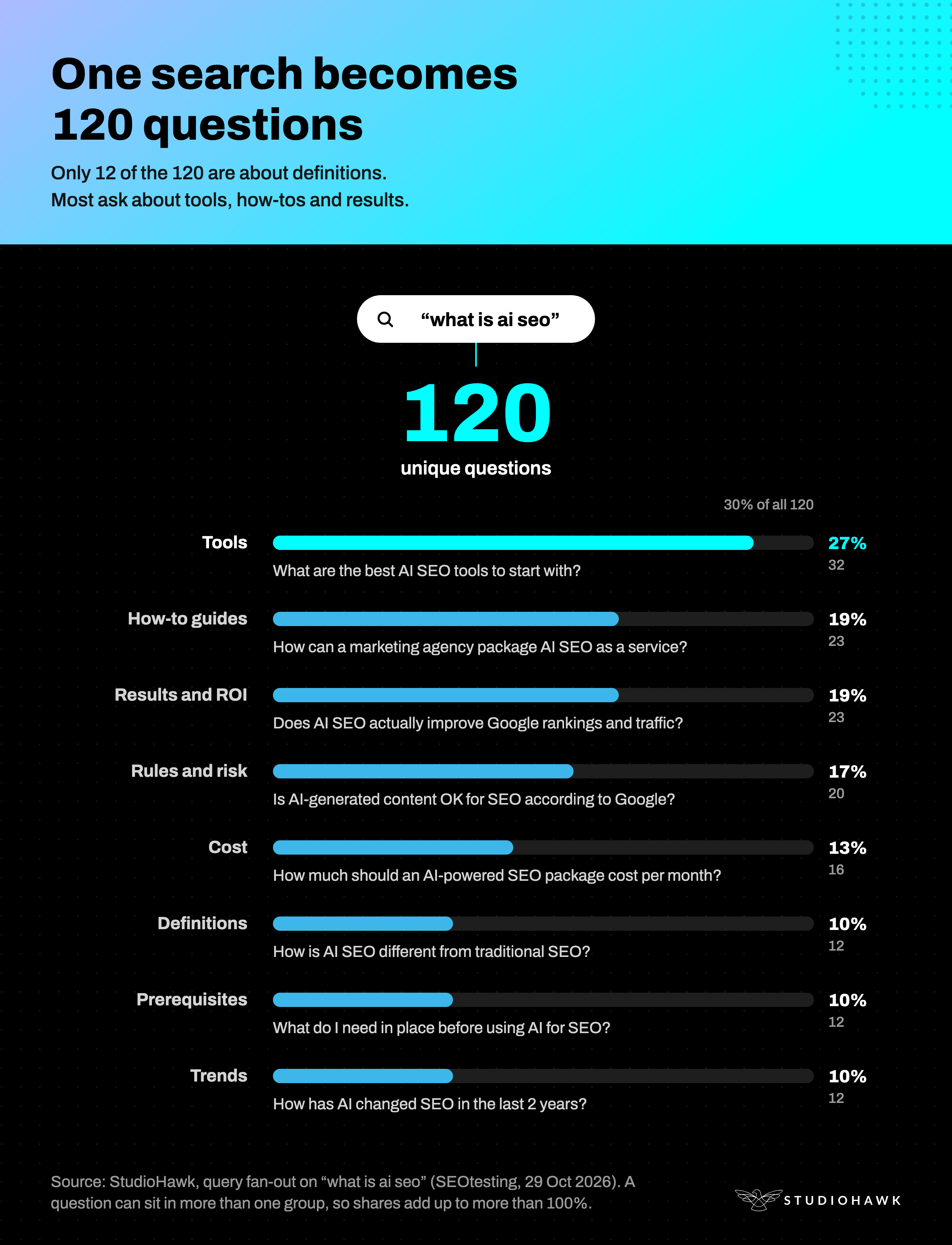
Source: StudioHawk, query fan-out run on "what is ai seo" (SEOtesting, Oct 29, 2026)
Your page competes on all 120 questions, so the depth of your topic coverage decides how many it can answer.
Do AI SEO hacks work?
Yes, some AI SEO hacks work, for now.
We know because we tested them.
We still do not build client strategies on them, because they are the keyword stuffing of AI search.
We tested the self-promotional "best of" list twice
In August 2025, Lawrence Hitches published a "best SEO agencies in Sydney" list on his personal site and included himself.
Within two weeks, the site appeared across AI tools for "best SEO agency Sydney" searches.
To rule out the StudioHawk name doing the work, we repeated it on a brand-new landscaping test site with a "best landscapers in Melbourne" list.
Within two weeks, that list appeared in AI answers too (full write-up on Search Engine Land).

Appearing in an AI answer is easy to fake, so appearing alone proves very little.
The other common tricks:
- Manufactured mentions, seeding the same claim across many low-quality pages so it looks like consensus.
- Poisoning the training data: research from Anthropic, the UK AI Security Institute and the Alan Turing Institute found that as few as 250 malicious documents can produce a "backdoor" in a large language model, regardless of the model's size.
AI systems do not yet have the spam defences search engines took decades to build.
That is why these tricks work today.
Google's history tells you how the story ends: tactic after tactic that gamed rankings became a penalty.
Build on the foundations, and you never have to unwind anything.
The AI SEO mistakes we see most
The biggest mistake is assuming AI SEO means publishing more content faster. More content only helps when it is good. The others we see most often:
- Publishing generic, unedited AI-written articles
- Chasing trends without a long-term strategy
- Choosing topics on search volume and ignoring search intent
- Treating AI SEO as separate from technical SEO
- Over-optimising headings until they read like a robot wrote them
- Neglecting internal links
- Publishing informational content with no path to a sale
Behind all of them is the same habit: output put ahead of usefulness.
How do you measure AI SEO?
You measure AI SEO with three numbers: how often you appear in AI answers, how much traffic AI sends you, and whether what AI says about you is right. The practical tracking methods are covered in our guide to AI SEO metrics.
What to measure | How |
Visibility in AI answers | Prompt tracking tools such as Peec AI, run against the questions your buyers ask |
AI referral traffic | GA4, with a channel group or segment for chatgpt.com, gemini.google.com, copilot.microsoft.com and perplexity.ai |
Google AI features | Search Console counts AI Overview and AI Mode traffic inside the normal "Web" search data (Google), so it cannot be separated there |
Accuracy | Ask the main assistants about your brand each month and log what they get wrong |
No tool sees every conversation.
Prompt tracking is a sample, so track the same questions over time and read the trend.
Compare your share of voice against competitors, and read it alongside your other numbers, because it only works as one signal among several.
Measure what AI changes in your sales pipeline
The best AI SEO signal sits in your pipeline. When we tracked StudioHawk's own inbound leads between July and December 2025, leads that came through AI search closed in roughly 18 days, against an average of 29 days for SEO leads.
Those buyers arrived already informed, so sales calls skipped the early education. In the first year we tracked AI search, AI-influenced conversations brought in over A$100,000 in closed revenue from more than 20 leads in 2025.
Some were traced straight to ChatGPT, Perplexity and Grok (Search Engine Land).
Attribution misses a lot of this.
On Black Friday, a Kadi customer found the brand through ChatGPT, browsed, added three more products, and placed the largest order of the sale.
Analytics credited Instagram.
Track three softer signals too: leads that mention AI tools unprompted, faster closes, and less pushback on price.
View this post on Instagram
How do you use AI to do SEO?
The other meaning of AI SEO is using AI tools to do SEO work faster.
We use AI every day for keyword clustering, content briefs, technical audits and internal linking suggestions.
A person still decides what to publish and checks every fact.
Google's position on AI-written content is clear: it rewards helpful content however it is produced, and warns that generative models "may contain inaccuracies" (Google Search Central).
Language models predict the next word, so they can state a wrong fact with confidence.
Use AI to go faster, and keep a person checking the facts.
Where should you start with AI SEO?
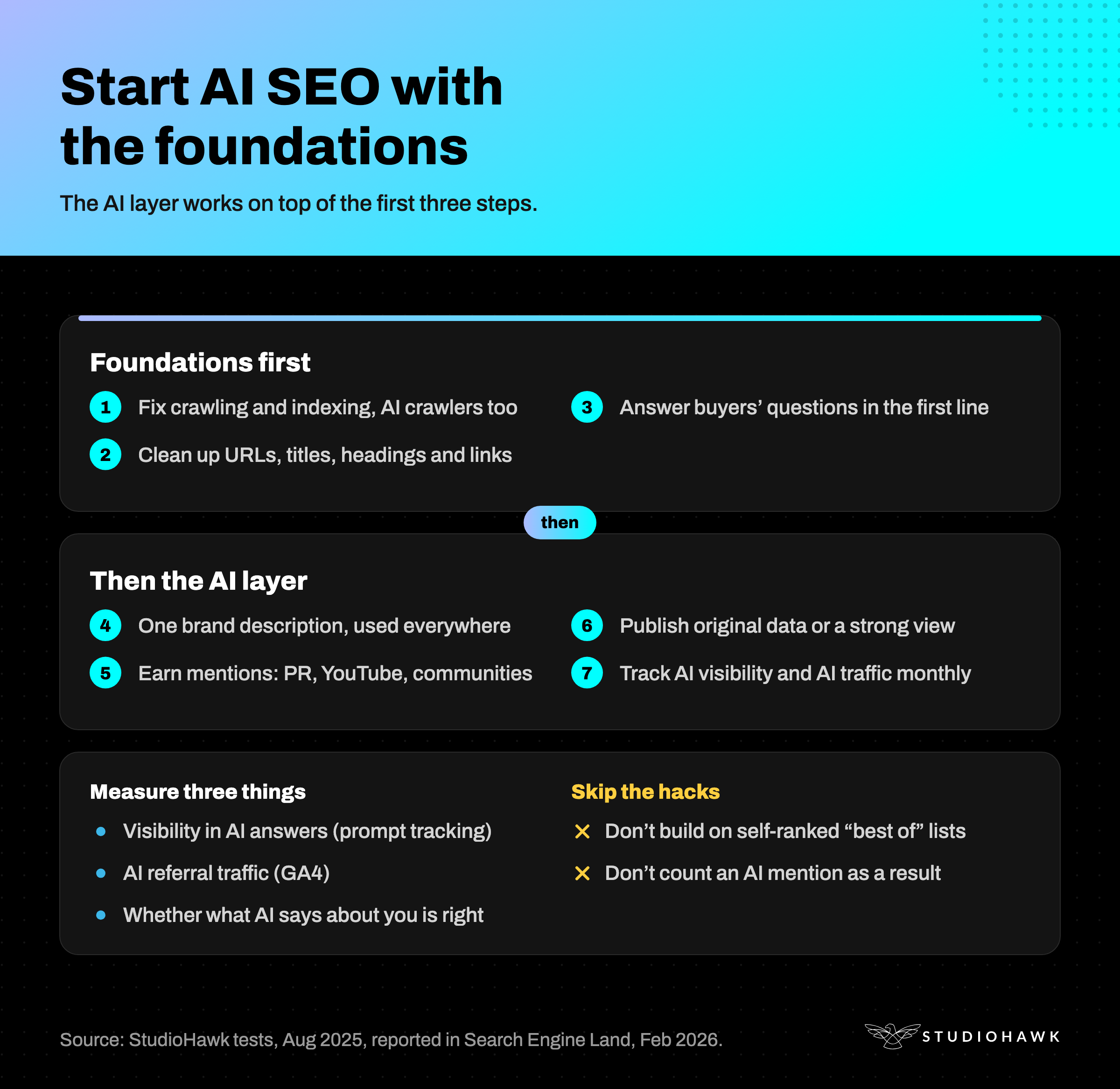
Start with the SEO foundations, then add the AI layer.
In that order:
- 1. Fix what stops crawling and indexing: Check that AI crawlers can reach your site with our free AI bot access checker.
- 2. Clean up URLs, titles, headings and internal links.
- 3. Build the pages your buyers' questions need, in topic clusters, with answers in the first sentence.
- 4. Write one clear description of your brand and use it everywhere.
- 5. Earn mentions off your site: digital PR, YouTube, the communities your buyers use.
- 6. Publish something original: data, a benchmark, a strong view with evidence.
- 7. Track your AI visibility and AI traffic monthly.
If you want a team to do this with you, our AI SEO services start with an audit of exactly these seven steps.
To work through them yourself, download our free AI search whitepaper, a practical guide to ranking in AI search with a checklist of high-impact fixes.
FAQ
Is AI SEO the same as GEO?
AI SEO and GEO are the same work under different names. GEO (generative engine optimisation), AEO and LLMO all describe getting your brand cited in AI-generated answers.
The distinctions between SEO, GEO and AEO are smaller than the labels suggest.
Does Google penalise AI-written content?
Google penalises AI-written content only when it is unhelpful or made mainly to manipulate rankings, the same rule it applies to any content. Accuracy and quality are what count.
How long does AI SEO take?
AI SEO usually shows early movement in AI visibility within a few months, because AI answers draw on content that already exists. Foundations and off-site authority take longer, and they are what make the gains last.
Can a small business do AI SEO?
A small business can do AI SEO, and it starts in the same place as any business: a technically sound site, clear service pages, a Google Business Profile, reviews, and one consistent description of what you do.
Do I need llms.txt for AI SEO?
You do not need llms.txt to appear in Google's AI features.
Google says there are no additional requirements or special optimisations to appear in AI Overviews or AI Mode.
Adding one does no harm: we have seen no significant upside or downside from it. More detail on llms.txt.
Further reading
- AI SEO Audit: The Beginners Guide for UK Businesses: how to check where your site stands in AI search before you change anything.
- How to Claim Your Business on ChatGPT in the UK (2026 Guide): the steps to put your own business details into ChatGPT.
- Why "Get Us Into AI Search" Is the Wrong Brief: how to set an AI search goal your team can act on and measure.
Get your brand into AI answers
StudioHawk's London team runs AI SEO for UK businesses, from technical foundations to the mentions AI tools look for. See our AI SEO services.
Sources
- SparkToro, New research: search happens everywhere (Rand Fishkin), 3 March 2026
- Google, AI Mode now available on Google Search in the UK, 28 July 2025
- Google Search Central, AI features and your website, last updated 10 December 2025
- Google Search Central, Google Search's guidance on generative AI content on your website, last updated 1 October 2026
- Anthropic, A small number of samples can poison LLMs, 9 October 2025
- Search Engine Land, What 4 AI search experiments reveal about attribution and buying decisions
- Add To Cart podcast, AI Search Rewards the Boring Work: Ecommerce SEO, Collection Pages and AEO with StudioHawk (episode 670), 7 October 2026