Enterprise SEO is not simply SEO with a bigger website. It is a different operational challenge altogether. You are dealing with multiple stakeholders, layered approval processes, complex CMS environments and thousands or even millions of URLs.
In that environment, performance measurement has to be commercially aligned, strategically focused and defensible at the board level.
If you are setting KPIs for enterprise SEO, the objective is not to track more metrics. It is to track the metrics that drive business decisions.
Why Enterprise SEO KPIs Need a Different Approach
Large organisations typically operate across multiple service lines, regions or product categories. They often have separate marketing, product and development teams, all with competing priorities.
Because of this, reporting purely on traffic growth is not enough.
Enterprise SEO KPIs must:
- Align directly with revenue and commercial performance
- Reflect technical scalability and site health
- Demonstrate incremental, non-brand growth
- Provide clarity for executive stakeholders
- Support resource prioritisation
Google’s guidance on creating helpful, people-first content reinforces that SEO success should be measured by real value delivered to users, not vanity signals such as rankings alone
Enterprise KPI frameworks must reflect that principle and focus on "Strategic Execution".
The video below briefly explains the importance of Execution in big firms*
Start With Business Objectives, Not SEO Metrics
Before defining KPIs, clarify what the business expects from organic search.
Imagine a London-based fashion brand in Shoreditch that is investing heavily in paid social and Google Ads but wants more predictable, lower-cost growth. The expectation from SEO might be to bring in people searching for things like “independent designer dresses London” or “ethical clothing UK”, attract visitors who are already close to buying, and support both online sales and store traffic to a physical showroom. In this scenario, success is not just more traffic on a dashboard, but it is fewer wasted ad clicks, stronger brand discovery outside marketplaces, and a steady stream of qualified customers who already trust the brand before they even land on the site.
In enterprise environments, SEO typically supports one or more of the following goals.
Revenue Growth
For e-commerce, SaaS or lead generation businesses, revenue is the core driver.
Instead of reporting traffic in isolation, connect organic performance to:
- Revenue generated from organic sessions
- Lead volume and sales-qualified leads
- Conversion rate by landing page type
- Average order value from organic users
This is where strong collaboration between SEO and analytics teams becomes essential. If tracking is inaccurate, KPI reporting becomes unreliable.
For organisations investing heavily in organic growth, this often sits within a broader Enterprise SEO strategy, where forecasting and modelling are critical.
Market Share Expansion
Enterprise brands often dominate branded search. That does not mean they are capturing new demand.
Non-brand visibility is where real growth happens.
Focus on:
- Non-brand impressions and clicks
- Ranking distribution for high-intent keywords
- Coverage within priority topic clusters
- Share of voice versus key competitors
Ahrefs argues that separating branded and non-branded traffic is essential for understanding genuine acquisition growth.
If non-brand visibility is flat, the business is not expanding its digital footprint, regardless of brand strength.
This is particularly relevant when aligning SEO with content marketing strategy and long-term authority building.
Core Enterprise SEO KPIs to Track
Rather than drowning in dashboards, focus on metrics that support strategic decision-making.
It is easy to track impressions, clicks and rankings across hundreds of pages, but those numbers only become valuable when they help answer real business questions such as which service lines deserve more investment, where organic search is reducing paid media spend, or which content themes are driving qualified enquiries rather than casual browsing.
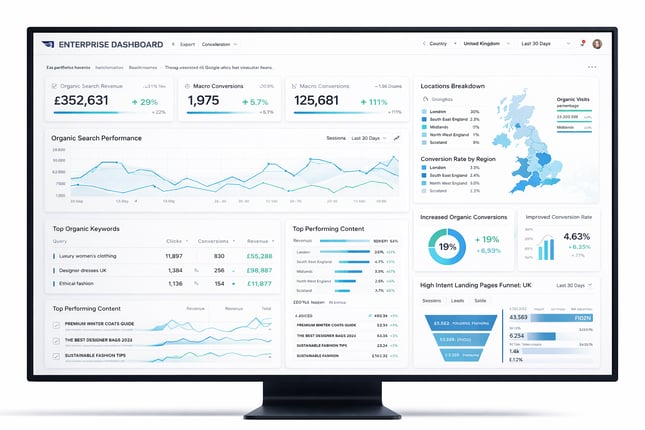
Strategic metrics that are accurate turn reporting into direction!
They help marketing leads decide whether to scale a content cluster, refine internal linking, adjust localisation for UK regions or support commercial teams with higher-intent traffic. In practice, this means shifting the focus from “what happened” to “what should we do next”, so SEO reporting becomes a decision-making tool rather than just another performance summary.
Organic Revenue and Conversion Performance
At the enterprise level, revenue is the clearest success indicator.
Track trends over time and segment by:
- Brand versus non-brand
- Product or service category
- Region or subdomain
- Device type
Segmentation reveals whether growth is coming from real market expansion or simply increased brand demand.
If conversion rates are weak, SEO must collaborate closely with CRO and UX teams. Organic traffic without conversion efficiency does not deliver commercial impact.
Share of Voice Across Strategic Clusters
Tracking thousands of keywords individually is not practical at scale.
Tracking thousands of individual keywords might look thorough on paper, but in practice, it is inefficient and difficult to manage at scale. Reporting becomes noisy, trends are harder to interpret, and insights often fail to connect back to commercial performance.
A more strategic approach is to group keywords into meaningful commercial themes. These clusters might reflect product categories, service lines, audience segments or geographic regions. Instead of monitoring isolated rankings, you measure share of voice and overall visibility within each thematic group.
This method provides a clearer, more commercially relevant view of performance.
-
First, it reflects true market penetration. Rather than celebrating a handful of high-ranking terms, you can assess how visible your brand is across an entire category or service area.
-
Second, it aligns SEO reporting with business structure. Most organisations are built around products, services or regional divisions, so keyword clusters that mirror this structure make performance data easier for stakeholders to understand and act on.
-
Third, it supports prioritisation decisions. When visibility is mapped to commercial themes, it becomes obvious where investment is required and where growth opportunities exist.
-
Finally, it demonstrates competitive positioning in a meaningful way. Measuring share of voice within a defined keyword cluster shows how you compare to competitors across an entire market segment, not just for isolated queries.
In short, thematic clustering transforms keyword tracking from a tactical exercise into a strategic performance framework.
For brands investing in digital PR services, this metric can also highlight where authority-building campaigns are influencing visibility at the category level.
Technical SEO Health at Scale
Enterprise websites frequently suffer from crawl inefficiencies, index bloat and rendering challenges.
Core technical KPIs include indexation rate, crawl error trends, internal linking depth and site speed performance.
At enterprise scale, technical SEO is not a one-off audit. It requires ongoing monitoring, structured roadmaps and collaboration with development teams.
This is where a structured technical SEO audit process becomes commercially critical rather than simply best practice.
Content Performance by Page Type
Enterprise sites are usually template-driven. Product pages, category pages, blog content, location pages and support documentation all behave differently.
Instead of reviewing pages individually, measure performance at template level.
Analyse:
- Traffic by page type
- Conversion rate by template
- Indexation success
- Engagement trends
If thousands of pages underperform, the issue is often structural rather than editorial. This distinction is crucial when prioritising development resources.
This also informs decisions around SEO content strategy, particularly where template optimisation can deliver scaled uplift.
Leading and Lagging Indicators
Enterprise reporting must balance immediate signals with long-term outcomes.
Lagging indicators such as revenue, conversions and organic traffic demonstrate results, but they move slowly. Leading indicators such as improved internal linking, content expansion or technical fixes signal future growth.
Operational SEO teams should be accountable for leading indicators. Executive stakeholders should focus on lagging, commercially meaningful metrics.
Both are required for a mature enterprise SEO programme.
Structuring Enterprise SEO Reporting
One dashboard rarely works for everyone.
Executive reports should translate SEO and marketing performance into commercial signals such as revenue impact, pipeline growth, customer acquisition efficiency and share of search, ending every update with decisions like “increase investment”, “hold”, or “reallocate budget”.
Marketing leadership reporting should focus on channel contribution, showing how organic search influences paid efficiency, content assists conversions, and technical improvements unlock growth opportunities, with clear next steps such as prioritising specific campaigns, shifting focus to high-ROI themes or aligning teams around quarterly objectives. Operational reporting should be task-driven, tracking implementation velocity, technical errors, crawl health, content delivery and testing progress, paired with immediate actions like fixing indexing issues, accelerating page launches or resolving tracking gaps
Clear segmentation of reporting prevents confusion and builds stakeholder trust.
Common Enterprise KPI Mistakes
Many large organisations still fall into avoidable traps.
Overemphasis on rankings without commercial context is one of the most common. Rankings fluctuate and do not guarantee revenue. Total traffic growth without segmentation can mask stagnation in non-brand acquisition. Impressions are frequently reported despite having limited board-level relevance.
Another mistake is measuring activity rather than outcomes. Publishing more content is not a KPI. Improved visibility, revenue contribution and market share are.
If your reporting cannot answer how SEO contributes to business growth, it needs restructuring.
Setting Realistic Benchmarks
Enterprise SEO growth is often incremental due to scale and internal constraints.
When benchmarking performance:
Compare year-on-year rather than month-on-monthWhen setting performance benchmarks, year-on-year comparisons are far more meaningful than month-on-month tracking. Monthly data is often volatile, influenced by campaign timing, search demand shifts or minor ranking changes. Year-on-year analysis smooths out noise and provides a clearer view of true progress across comparable periods.
Account for seasonality and industry trends
Seasonality and wider industry trends must also be factored in. Many enterprise sectors experience predictable peaks and troughs. Retail brands may see Q4 spikes, travel brands may surge in summer, and B2B services often slow during holiday periods. Benchmarking without accounting for these patterns can create false positives or unnecessary alarms.
Factor in algorithm updates
Algorithm updates are another critical variable. Core updates, helpful content changes and spam updates can temporarily impact visibility across entire sectors. Performance dips or gains during these periods should be assessed in context rather than treated as isolated SEO successes or failures.
Consider the impact of migrations or technical changes
Large-scale migrations and technical changes can also distort short-term data. Platform changes, URL restructures, domain consolidations or significant technical clean-ups may cause temporary volatility before stabilising. Benchmarks should consider these strategic shifts and allow time for re-indexing and recovery.
Stable, compounding growth is usually a stronger indicator of success than short-term spikes.
Turning KPIs Into Strategic Decisions
KPIs are not simply reporting tools. They should drive prioritisation.
If non-brand growth stalls, investment may need to shift towards authority-building and topical expansion. If indexation is low, technical improvements must take priority over content production. If conversion rates are weak, SEO should align with CRO initiatives.
Enterprise SEO is ultimately about resource allocation. KPIs provide the evidence required to justify investment, roadmap changes and cross-team collaboration.
The Bottom Line
Enterprise SEO performance measurement is about clarity, accountability and commercial alignment.
The right KPIs will:
- Connect directly to revenue and growth
- Demonstrate expansion beyond brand demand
- Reflect technical scalability
- Support executive-level decisions
- Guide strategic prioritisation
Anything else is noise.
If your enterprise SEO reporting is not influencing board-level conversations, it is time to rethink your framework.
Need help growing your organic traffic?
If you're unsure where to begin or want expert support to build a content strategy that actually delivers results, speak to the team at Studiohawk. We'll help you create and maintain content that remains relevant, useful, and optimised for long-term growth.
Contact our SEO experts today.
Book a free consultation and see what’s possible!